By Christopher George • The Gig Man’s Life • October 15, 2026
Breakfast Talk is presented by TheGigMansLife.com—also known as my wallet. That wallet would occasionally appreciate it if I finished talking and got out the door to make some money.
Thursday morning started with Uber and Lyft, took a detour through OpenSCAD and a box full of dovetails, and eventually returned to the question underneath all of it: who is responsible for making these systems work for the people using them?
I drive. I make things. I ask questions. Sometimes a squirrel grabs my attention halfway through a sentence. But there was a point to this morning’s wandering.
We need to talk about what these platforms ask of drivers, what they tell us, and what they leave us trying to figure out.
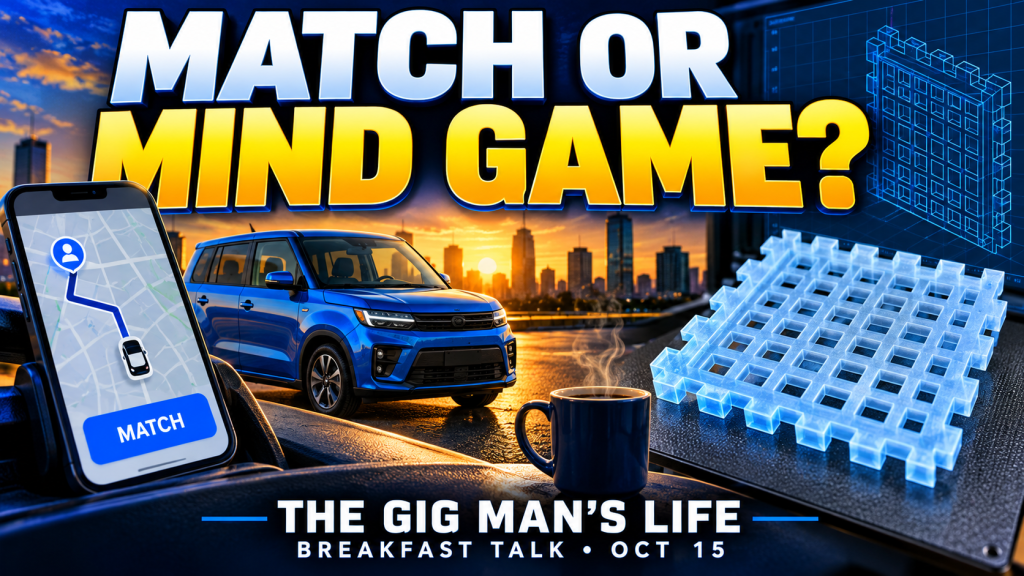
What is a match request really doing?
Here is my theory: Uber’s Match requests may serve another purpose alongside finding someone to take a ride. They may also keep drivers watching Uber instead of checking what Lyft has available.
Uber’s own explanation says Trip Radar can show a request to multiple drivers. Pressing Match expresses interest; it does not guarantee the trip. Exclusive requests work differently: accepting one assigns it to you. Uber says proximity and estimated pickup time factor into matching.[1]
That establishes how the feature works. It does not establish my theory about why it works that way.
But think about the experience. A possible job appears. You look at it. You request a match. You wait to see whether you get it. Another opportunity appears. Your attention stays on that platform.
A company competing for passengers also needs drivers available to serve them. Keeping our attention could have value even when an individual offer never becomes our assignment.
I cannot see Uber’s internal decision-making. I am asking whether driver engagement is part of the business effect—and whether drivers are gaining useful opportunities or spending more time chasing possibilities.
Show me where my time went
In Massachusetts, Uber currently lists a minimum earnings guarantee of $34.48 per active hour for eligible rides beginning in the state. Its calculation runs over a two-week earnings period. This is not a separate $34.48 hourly payout attached to every trip, and it does not cover every minute spent online.[2]
That distinction makes accurate, accessible records essential.
I want to see when I accepted, when I arrived, when the ride ended, and who canceled. If it was a cancellation, record the reason. Show the eligible time, the excluded time, and how that decision affected the earnings calculation.
Do not make me reconstruct my workday from scattered screens and support conversations.
Uber’s published explanation excludes time on trips the driver cancels before drop-off. It also excludes driving after notification that a passenger canceled.[2] Those categories deserve scrutiny when the driver has already traveled to a pickup and discovers a safety problem.
Too many passengers. Luggage that cannot be carried safely. A child who needs a restraint that the passenger has not brought.
The trip cannot proceed, but the trip to the pickup already happened.
My proposal is a minimum six-minute time credit when an accepted assignment begins, with additional eligible time counted beyond it and protection for documented safety refusals. That is a proposal—not a claim about today’s rules. At the current rate, six minutes represents approximately $3.45 toward the guarantee calculation.
We can debate the precise mechanism. We should agree that refusing an unsafe trip deserves its own clear record and fair treatment.
“You’re the only driver who does this” is not an argument
After years in corporate security, IT security, and now gig work, I recognize that line.
Someone else supposedly allowed it. Someone else did not ask. Someone else looked the other way.
Fine. Someone else is not operating my car.
A passenger’s frustration does not make an unsafe arrangement acceptable. Drivers need a straightforward way to document the issue, refuse the trip, and have the decision reviewed fairly. Cameras can help document events, but the platform’s own records should be useful too.
Make the controls fit the job
Part of my preference for Lyft lately comes from the controls I encounter in my own workflow. An arrival action should communicate that I have arrived. I should not need another trip through the menus just to repeat the same message.
And choosing not to be paired with a passenger again should be separate from deciding whether that passenger deserves a poor rating. Sometimes a trip is simply an interaction I would prefer not to repeat. That preference should be handled consistently with nondiscrimination requirements, without forcing the rating system to do every job.
My larger request is straightforward: make common safety actions easy to find and consistent to use. Arrival, cancellation reasons, reporting, and future matching preferences should not become little administrative projects between rides.
The fewer unnecessary steps, the more attention we can give the actual work.
Switching apps does not reset a tired driver
Call it rideshare, delivery, or DoorDashing. We are transporting people or goods.
I have done delivery work and then considered adding rideshare hours afterward. Changing the app does not erase the work already done.
CDC/NIOSH describes fatigue-related impairment after prolonged wakefulness as comparable to alcohol impairment: around 17 consecutive hours awake can resemble a blood alcohol concentration of 0.05%, and 24 hours can resemble 0.10%. Those figures concern time awake, not simply time driving.[3]
That is why I predict pressure for some form of shared work-hour accounting across platforms. I am not announcing an existing universal government sign-in system or claiming that a particular regulation is scheduled.
Any such proposal would need to distinguish overlapping app time, actual work, and genuine breaks. Otherwise, a system intended to improve safety could build its decisions on bad records.
Companies have an opportunity to improve their own practices now. I would rather see them resolve the practical problems than wait for a rulebook to specify every last detail.
Who helps when the vehicle stops?
The robotaxi debate also needs to extend beyond whether a vehicle can navigate a road.
What happens when a passenger collapses? Who can physically assist them? Who meets emergency responders and explains what happened?
A remote voice can summon help. A trained person in the vehicle may be able to provide help while responders are on the way. Those are different capabilities.
My position is that passenger transportation should retain trained onboard attendants, with clear responsibilities and appropriate pay. Putting a person in the seat without training does not automatically solve the problem.
The closing discussion also raised intoxicated passengers and self-driving personal vehicles. I would not present that comparison as an established legal loophole: responsibility depends on the vehicle, the person’s role, and the applicable law. The question I want answered is broader: who is responsible for the passenger when the ride needs more than navigation?
And then we built a box
Yes, this morning also involved a considerable amount of CAD.
I worked through dovetail bars, grate openings, recessed panels, and the order in which the pieces could actually go together. A design can look convincing on screen and still leave you asking how the final panel gets into place.
Later, the printed pieces went together with deliberate press-fit effort. The grate seated inside the surrounding walls, and the adjustable recess depth let me change the thinner panel areas while retaining material around the connections. That is a useful prototype result; long-term durability still has to be demonstrated.
There is a connection to the rest of the conversation. When something does not fit, I have to examine the dimensions, the orientation, and the assembly process. I cannot argue the plastic into cooperating.
Transportation platforms should be willing to examine their systems with the same practicality. Listen to the people using them. Make the records visible. Fix controls that create unnecessary work. Explain how decisions are made.
That is why this is The Gig Man’s Life. Earning a living includes the driving, the learning, the building, and occasionally spending too much of the morning figuring something out.
Bring your disagreements. Bring your experience. It is a two-way conversation.
Have a fun, safe, and profitable day.
Presented by TheGigMansLife.com—aka my wallet.
Source notes
Policy details checked October 15, 2026. Statements about platform incentives and future shared work-hour tracking are the author’s theories and predictions.