By The GigMan’s Life | October 28, 2026
Massachusetts is preparing significant changes to how rideshare companies and their drivers are regulated. Some of these changes could improve passenger safety, driver training, and accountability. But one important question deserves attention before the state finalizes its regulations:
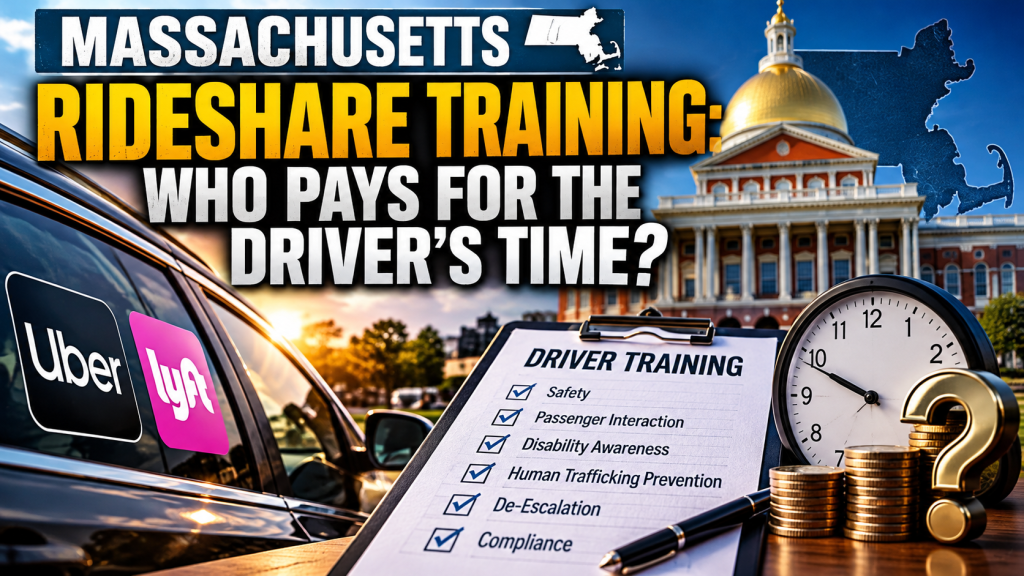
Who is going to pay for the driver’s time spent meeting these new requirements?
During this morning’s Breakfast Talk, we examined a Massachusetts Department of Public Utilities (DPU) rulemaking proceeding known as D.P.U. 26-90. It proposes new standards for Transportation Network Companies (TNCs), including Uber and Lyft.
Among those proposals are annual driver training, stronger background-check requirements, revised driver suitability standards, safety-related deactivation reporting, and improved appeal procedures.
There is a lot to unpack here, particularly concerning the practical responsibilities being placed on drivers.
Annual Training Is Coming Into Focus
Under proposed regulation 220 CMR 274.04(4), rideshare companies would be required to ensure that all drivers complete an annual safety and professional driving program.
The draft says that training must be completed at the transportation network company’s expense and would be a condition of using its digital network.
The proposed curriculum includes defensive driving and road safety, serving passengers with disabilities, human trafficking awareness and prevention, distracted driving, and managing passenger interactions.
That last category includes de-escalation techniques and dealing with intoxicated, unruly, or violent passengers, as well as unaccompanied minors.
These are relevant subjects for anyone transporting members of the public.
I have advocated for proper rideshare driver training for some time. Having spent years working in corporate security and IT security, I understand the value of documented instruction and annual compliance reviews.
But training must be more than a video, a checkbox, and an acknowledgment that someone supposedly understands the rules.
Companies need to establish what drivers are expected to know, provide meaningful instruction, and verify that the instruction was understood.
The question is how Massachusetts intends to make that happen.
At the Company’s Expense Doesn’t Necessarily Mean Paid Training Time
Here is the part of the proposal that particularly caught my attention.
The state specifically says the training would be conducted at the TNC’s expense.
That addresses the cost of providing the program. It does not clearly answer whether drivers will be compensated for the time they spend completing the program.
Consider what happens if a company requires an annual training session that takes two or three hours.
Those are hours the driver cannot spend accepting rides and earning income.
Massachusetts already has a minimum earnings guarantee for Uber and Lyft drivers established through the Attorney General’s 2024 settlement.
As of January 15, 2026, that guarantee is $34.48 per hour of engaged time. But engaged time generally begins when the driver accepts a trip and ends when the passenger is dropped off.
Completing a training program is not the same thing as completing a passenger trip.
Does the state intend to compensate drivers for mandatory training, or will that time become another unpaid responsibility?
The draft regulation does not explicitly answer that question.
For drivers who already absorb the costs of their vehicles, fuel, insurance, maintenance, and considerable time spent waiting for rides, additional uncompensated administrative work deserves examination.
Will Drivers Have to Complete Separate Training for Every Platform?
Another concern involves drivers working with multiple rideshare companies.
If Massachusetts establishes minimum training standards, will one completed and verified program satisfy those standards for every participating TNC?
Or will Uber require its own training, Lyft require another, and additional companies impose their own versions?
The proposed rule places responsibility on each TNC to require annual training. It does not clearly establish a universal certification accepted across platforms.
That creates the possibility of duplicated work.
A driver might be required to complete substantially similar programs multiple times, simply because the companies operate separate applications.
A statewide baseline certification, with additional company-specific instruction where necessary, is one possible approach worth examining.
The important thing is ensuring drivers actually understand the requirements without creating unnecessary repetition.
Compliance Requires Documentation and Accountability
Training needs to be documented.
If companies are going to require annual recertification, drivers should receive a verifiable completion record showing what training was completed, when it was completed, and when any renewal is due.
Drivers should also have sufficient advance notice and a reasonable opportunity to complete the program.
What happens if the application fails to register the completed training? What if a driver cannot access the required modules? What accommodations will be provided when training materials are inaccessible?
These are not minor administrative details when a driver’s ability to earn income depends on remaining compliant.
The proposed rule makes training a condition of accessing the platform. That makes reliable recordkeeping and correction procedures especially important.
Deactivation Reporting and Appeals Are Also on the Agenda
The December discussion will not be limited to training.
Massachusetts is also examining how companies report safety-related driver deactivations and what minimum standards should apply to internal appeals.
The proposal would formalize reporting of drivers deactivated for public-safety-related reasons. It defines a deactivation, for these purposes, as loss of access to a company’s digital network for more than five consecutive calendar days.
This is an important distinction.
A company’s decision to deactivate a driver does not automatically mean that Massachusetts has revoked the driver’s state clearance or that every other company must deactivate that driver.
However, sharing and reporting serious safety information creates a need for accurate records and meaningful procedures to correct mistakes.
The proposed appeal standards would require more detailed explanations of deactivation decisions and access to material information, or a detailed description of it, subject to privacy protections.
That is a development drivers should examine carefully.
It is difficult to respond meaningfully to an accusation without knowing the incident being alleged, the relevant circumstances, and what evidence a company relied upon.
Protecting passenger privacy matters, but it must also be possible for a driver to challenge incorrect information.
As Massachusetts strengthens its reporting systems, it should consider how disputed findings are identified, how corrections are communicated, and how drivers can prevent inaccurate information from following them across platforms.
December 8 Is an Important Date for Drivers
The DPU has scheduled another technical session for Tuesday, December 8, 2026, at 10 a.m., at One South Station in Boston.
The published agenda includes driver suitability, onboarding requirements, data collection, driver training, deactivation reporting, and minimum standards for internal appeals.
These proposals are still part of an ongoing rulemaking process. They should not be confused with requirements that have already taken effect.
The department has also acknowledged the ongoing collective bargaining process involving the App Drivers Union and rideshare companies in Massachusetts.
That makes the relationship between future regulations and negotiated driver working conditions particularly relevant.
This rulemaking specifically concerns transportation network companies providing passenger rideshare services. It should not be confused with regulations governing food delivery services such as DoorDash or Uber Eats.
Questions Massachusetts Needs to Address
Before these requirements are finalized, several practical questions deserve clear answers:
- Will drivers be paid for mandatory training time? If so, how will that compensation be calculated and documented?
- How long will annual training take? Will the state establish a consistent minimum curriculum and reasonable time expectations?
- Can training be recognized across multiple rideshare platforms? Or will drivers have to repeat the same instruction for every company?
- What happens when a driver cannot complete training because of a technical or accessibility problem? Will there be a correction process before platform access is restricted?
- How will deactivation reporting and appeals protect drivers against inaccurate information? What procedures will exist to correct records and communicate a successful appeal?
These are implementation questions that matter regardless of whether someone supports the overall proposal.
Safety Training Should Be a Shared Responsibility
There is nothing inherently wrong with expecting professional standards from people transporting passengers.
Drivers have responsibilities. Rideshare companies have responsibilities. Massachusetts has an oversight responsibility.
But if the state and the companies are going to require additional training and verification, they also need to address the consequences for the people performing that work.
Providing a free training program is not necessarily the same as making participation cost-free to the driver.
Time has value.
A driver who must complete additional administrative requirements has less time available to earn money, even if no training fee is charged.
The goal should be a system that provides meaningful instruction, documents compliance, protects passengers, and treats drivers fairly.
Massachusetts has an opportunity to clarify those expectations before the regulations are finalized.
The question is not simply whether drivers should receive training. It is whether the state will ensure that the responsibility for delivering and completing that training is shared fairly.
That is something worth watching as the December 8 session approaches.
It’s a Gig Man’s Life indeed.
Sources and Further Reading
- Massachusetts DPU — Proposed Changes to TNC Regulations, D.P.U. 26-90
- Proposed Regulations — 220 CMR 274–277
- December 8, 2026 — DPU Technical Session
- Massachusetts Attorney General — Uber and Lyft Settlement FAQ
- DPU Announcement — Proposed Rideshare Safety Regulations
Editorial note: This article discusses proposals and questions raised during an ongoing Massachusetts regulatory process as of October 28, 2026. Final requirements may differ.