A Coding We Will Go — The GigMan’s Life
There’s something I’ve noticed over my 14 years in the 3D printing hobby.
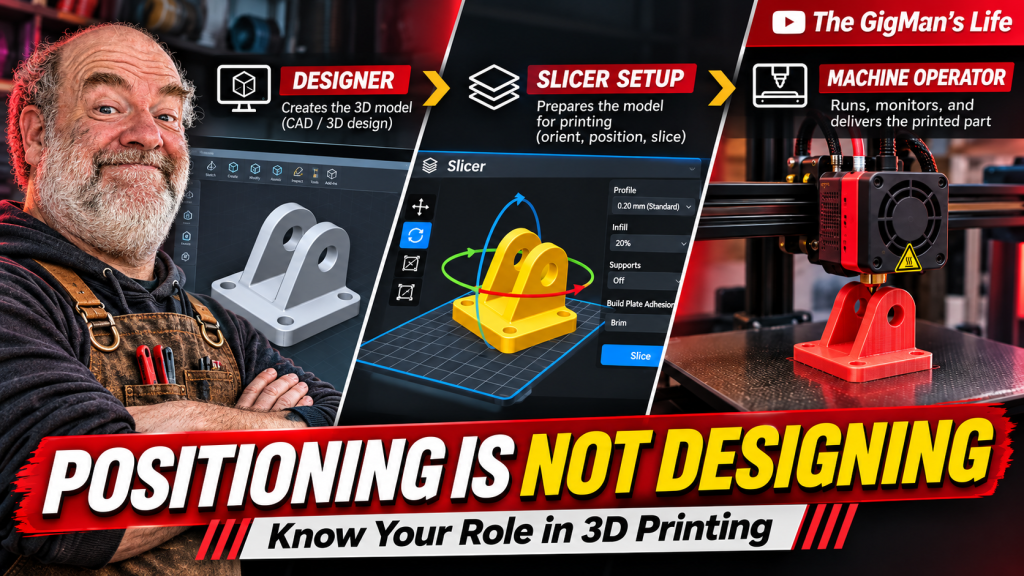
People often confuse designing something with preparing something for printing.
Someone tells me they’re designing an object, but when we start discussing what they’re doing, they’re actually trying to figure out how to position an existing STL file on the build plate.
Well, that’s not designing.
That’s preparing a model for production.
And while both activities require knowledge, they aren’t the same thing.
Designing Is Not Operating
Just because you operate a machine doesn’t mean you designed what that machine is producing.
A person running a CNC machine isn’t automatically the engineer who designed the part.
Likewise, someone downloading an STL, rotating it in PrusaSlicer, adding supports, and sending it to a 3D printer hasn’t necessarily designed anything.
They’re preparing and manufacturing an existing design.
But that doesn’t mean the machine operator doesn’t have valuable knowledge.
Sometimes the machine operator is the person who has to tell the designer:
“I don’t care how you slice this thing. This machine isn’t going to produce the part you’re expecting.”
And that can be absolutely correct.
You can reposition a model a hundred different ways, but if the machine cannot manufacture the required geometry, tolerances, or material properties, you’re not going to solve that problem simply by changing its orientation.
That’s why different manufacturing processes exist.
And that’s why a knowledgeable machine operator is an important part of production.
Why I’m Documenting This After 14 Years
I haven’t spent 14 years in this hobby just to discover that there’s a difference between designing something and printing it.
I’m documenting these things because I’ve spent those years working with the equipment, dealing with its limitations, solving problems, and seeing what happens when people misunderstand the process.
And through The GigMan’s Life, I have an opportunity to share that experience.
That’s part of the purpose of these articles.
Not simply to demonstrate how to operate software or equipment, but to explain the decisions, responsibilities, and practical knowledge involved.
Because something else needs to be understood.
A lot of hobbies eventually become businesses.
Someone buys a 3D printer because they want to make a few things around the house.
Then they start printing things for friends.
Maybe someone asks them to produce a replacement part.
Eventually, they begin accepting orders and charging people for the work.
Suddenly, what started as an enjoyable hobby has become a small manufacturing operation.
And that changes the expectations.
When you’re printing something for yourself, a failed print might mean wasted filament and a few hours of frustration.
When you’re producing something for a paying customer, you’re dealing with quality, costs, deadlines, suitability, and responsibility.
You need to understand what you’re offering.
Are you providing a design service?
Are you modifying an existing design?
Or are you simply providing a manufacturing service using somebody else’s model?
Those distinctions matter.
They affect what you’re promising the customer and what you’re responsible for delivering.
Recommendations Are Not the Same as Instructions
Another part of documenting these processes is making sure people understand the difference between a casual suggestion and a specific instruction.
If I tell somebody, “You might want to try this,” that’s a recommendation.
But if I’m walking somebody through a procedure and explaining the steps necessary to accomplish a task, I’m giving instructions.
I’m explaining what needs to be done, why it needs to be done, and what may happen if those steps are ignored.
If someone decides not to follow those instructions, that’s their choice.
But that choice also carries responsibility.
You cannot reasonably ignore a procedure, encounter the exact problem the procedure was intended to prevent, and then claim that the person who provided the instructions caused the problem.
Now, if I give incorrect instructions, that’s something I need to acknowledge and correct.
But if the instructions are accurate and you decide to do something entirely different, that decision belongs to you.
This is especially important when learning to operate manufacturing equipment.
The Difference Between a Hobby and a Business
One of the things that makes 3D printing interesting is how accessible the technology has become.
You can purchase a printer, download a model, and manufacture a physical object without having formal training in industrial manufacturing.
That’s a remarkable capability.
But accessibility doesn’t eliminate the need for knowledge.
And it certainly doesn’t eliminate responsibility.
When your hobby becomes a business, knowing how to push the Print button isn’t enough.
You need to understand the capabilities of your equipment, the limitations of the materials, and what constitutes an acceptable finished part.
You also need to recognize when you should tell a customer that your equipment is not suitable for the requested job.
That’s not admitting defeat.
That’s understanding the manufacturing process.
Experience Is Worth Sharing
After 14 years in this hobby, I can tell you that there are plenty of things people can learn without having to make every mistake themselves.
That’s why I’m documenting these subjects.
The OpenSCAD tutorials, the discussions about tolerances, the printer setup procedures, and the explanations of manufacturing limitations are all part of sharing practical experience.
People are free to follow the instructions, question them, investigate alternatives, or disregard them.
But I want the information clearly presented so people understand what they’re doing and why.
Because whether this remains a hobby or eventually becomes a business, the fundamentals don’t change.
Designing isn’t positioning. Positioning isn’t manufacturing. Operating a machine doesn’t automatically make you the designer. And ignoring instructions doesn’t make somebody else responsible for your decisions.
Learn the differences.
Understand the equipment.
Respect the process.
And take responsibility for the work you produce.
It’s a Gig Man’s Life indeed.