
One of the things I’ve always enjoyed about role-playing games is that they answer a simple question:
“What if?”
What if a wizard decided that physics was merely a suggestion?
What if a thief could steal the king’s crown while standing in the same room as him?
What if a dwarf looked at a dragon and said, “I have an idea, and it’s probably a bad one.”
And, apparently, what if I designed a weapon called the Hammer of Second Chances?
Now, somewhere along the line, somebody always decides to become the Fun Police and reminds me that I can’t bring imaginary weapons into the game.
To which I reply, “Then why are we playing a game based entirely on imagination?”
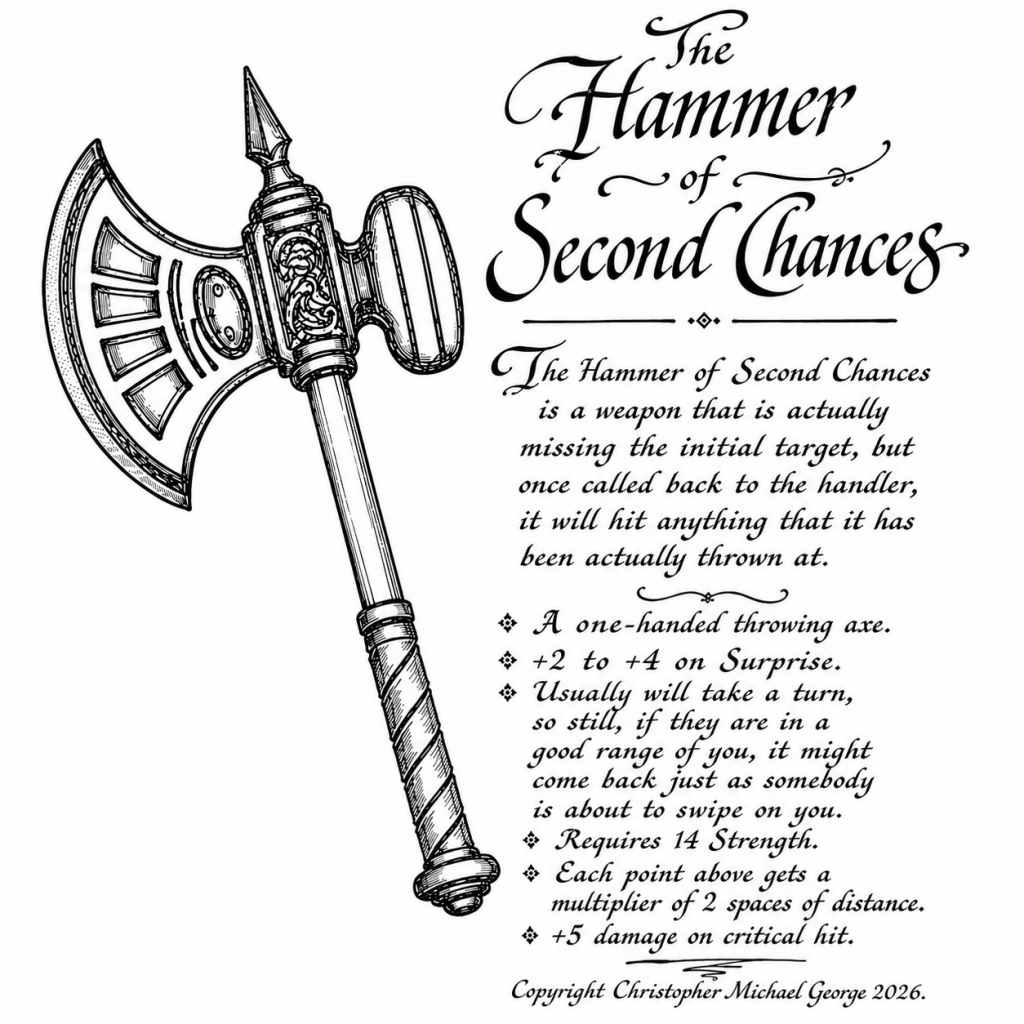
The Hammer of Second Chances started as a simple drawing. A one-handed throwing axe with a hammer head on the back. Decorative. Slightly ridiculous. The sort of thing that would make a blacksmith question your sanity and a barbarian immediately ask where he can get one.
Its special ability is simple.
The first throw can miss.
The second one doesn’t.
Once called back to the handler, the weapon returns and strikes whatever it was originally thrown at.
It’s the physical embodiment of every argument that begins with, “Wait, I’m not done talking.”
Mechanically, it isn’t even overpowered. It takes time to come back. In many cases, an enemy has enough opportunity to close the distance before the return strike arrives.
Which is where the fun begins.
Imagine somebody charging toward you after you’ve missed.
They’re feeling pretty confident.
They think they’ve won.
Then the axe comes screaming back from behind them.
It’s a backstabber in the most literal sense.
The current notes on the weapon are:
- One-handed throwing axe.
- +2 to +4 on surprise attacks.
- Requires 14 Strength.
- Every point of Strength above 14 adds two spaces of throwing distance.
- Usually requires one turn to return.
- +5 damage on a critical hit.
Is it balanced?
Probably not.
Will somebody eventually tell me why it breaks three different game systems and violates established weapon design principles?
Almost certainly.
Do I care?
Not really.
Because half the fun of role-playing games isn’t following the rules.
It’s imagining something ridiculous enough that your friends stop, stare at you, and ask:
“Where in the world did you come up with that?”
And then you get to smile and answer:
“Second chances.”