
There are moments when the past does not come back as a clean file, a certificate, or some perfectly archived record sitting there waiting for you.
Sometimes it comes back as a newspaper clipping in a package of old pictures.
That is what happened here.
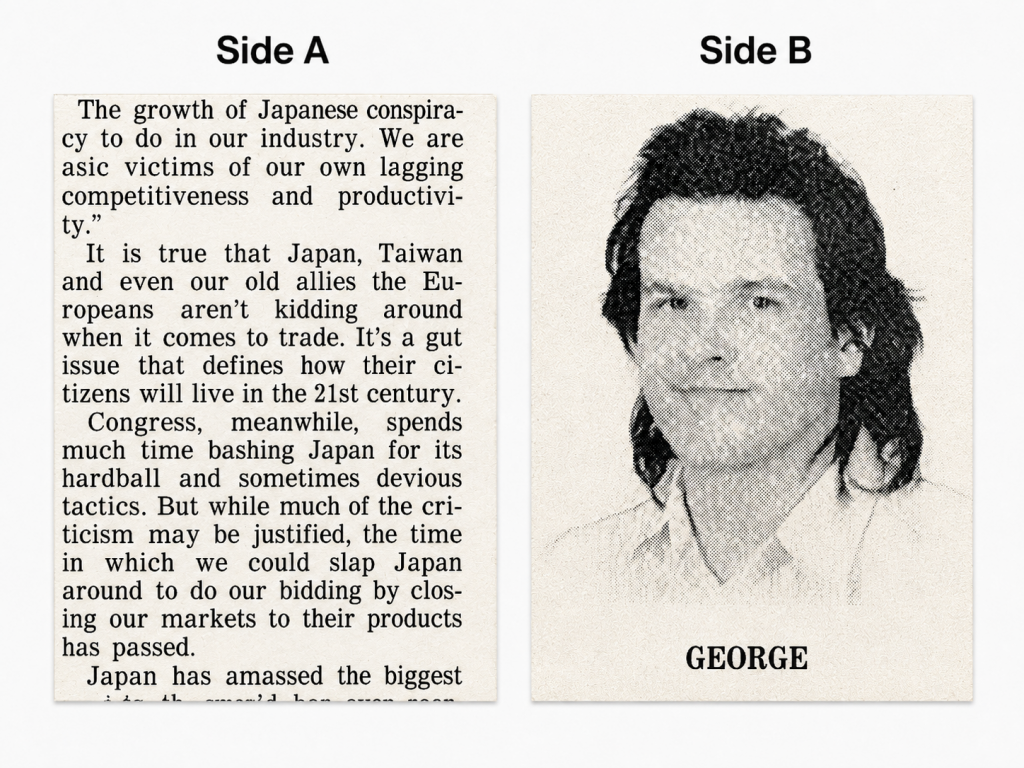
My sister Melinda found this clipping in a package of pictures. On one side, there is a picture of me with GEORGE printed underneath it. On the other side, there is part of another article. At first glance, you would think the picture side is the important part. And emotionally, yes, it is.
That is me.
That is the proof.
That is a younger version of me sitting there in newspaper dots, looking like somebody who still had a full head of hair.
And God, do I miss the hair.
I miss the hair so much.
But after getting past the hair, the younger face, and that weird feeling of looking at yourself from decades ago, the practical side of my brain kicked in. Because this clipping may not just be a piece of nostalgia. It may be a lead.
The strange part is that I was already looking for this.
This search had already started before the clipping showed up. I had already asked my niece, who is a librarian, about old newspaper articles and whether she had access to anything that could help. She pointed me toward the library route.
I still tried the newspaper first, because why not? Start with the source if you can. I reached out and asked about the article. They got back to me and said they could not find it. Their suggestion was basically the same one my niece had already given me: try the library.
So this clipping did not start the search.
It landed in the middle of one.
That is the coincidence.
While I was already trying to track down one of the only pieces of published material I ever had connected to my own artwork, my sister found a physical piece of it sitting in old family pictures. Not the whole article. Not the full page. Not the complete story. Just this small clipped-out piece of newspaper that somebody saved long enough for it to survive.
And now the funny part is this:
The side with my picture may not be the most important side.
That sounds strange to say. It feels strange to look at a picture of yourself and go, “Yeah, that is not the most useful part.” But when you are trying to find the original article, the picture is not always the best search tool.
The picture side tells me what I am looking for.
The back side may tell me where to find it.
That is why I am calling them Side A and Side B.
Side B is the personal proof. It has the photo. It has the name. It tells me this thing existed. It connects me directly to the award-winner article I am trying to find.
But Side A has text.
And text is searchable.
That matters when you are dealing with old newspaper archives. A scanned newspaper page is an image. It can be large, messy, and hard to search by itself. But when those pages are processed through OCR, optical character recognition, the printed words can become searchable text. Text takes a lot less storage than a full-page image, and it gives you something to hunt with.
You would be surprised how much smaller the text from an entire issue can be compared to the image file for one scanned newspaper page.
So the back side of this clipping, which has nothing to do with my picture, may be the better clue. It appears to be part of an opinion article about Japan, trade, Congress, competitiveness, and that whole late-1980s conversation about the United States, Japan, Taiwan, Europe, markets, and industry. That gives me words. It gives me phrases. It gives me something an archive might have indexed.
That is why Side A matters.
If I can take a unique phrase from that reverse-side article and find it in a newspaper database, I may be able to identify the exact issue, date, page, and section. Once I have that, I can go back to the physical layout of the paper and look for the article on the other side or nearby in that same issue.
That is the path.
Not guessing. Not just remembering. Not hoping somebody knows where it is.
Follow the text.
Find the issue.
Find the page.
Find the article.
This is why old paper matters. This is why someone cutting out a clipping and saving it matters. This is why family photos matter. Because sometimes proof does not come back to you as the whole answer. Sometimes it comes back as just enough to keep digging.
And that is where I am right now.
The newspaper could not find it from the information I had. The library was already the suggested route. My niece pointed me that way. The newspaper pointed me that way. Then Melinda finds this clipping, and suddenly I have a better lead than I had before.
The past did not hand me the full article.
It handed me a breadcrumb.
Side B says, “This was me.”
Side A may say, “Here is where to look.”
And somewhere in the middle of that is one of the only pieces of published material I may have from that time. A little award-winner clipping. A little piece of proof. A little reminder that before everything became digital, searchable, backed up, copied, pasted, downloaded, and thrown into the cloud, somebody still had to cut things out and keep them.
And thank God somebody did.
Because now I have the picture.
I have the name.
I have the back-side text.
And I have a reason to keep going.
Also, I still miss the hair.