
And yes, pragmatism is going to bother some people.
Pragmatism asks a very basic question: Does it work?
If the answer is yes, the next question becomes: Is this the most effective or elegant way it could work?
That second question is what we call research.
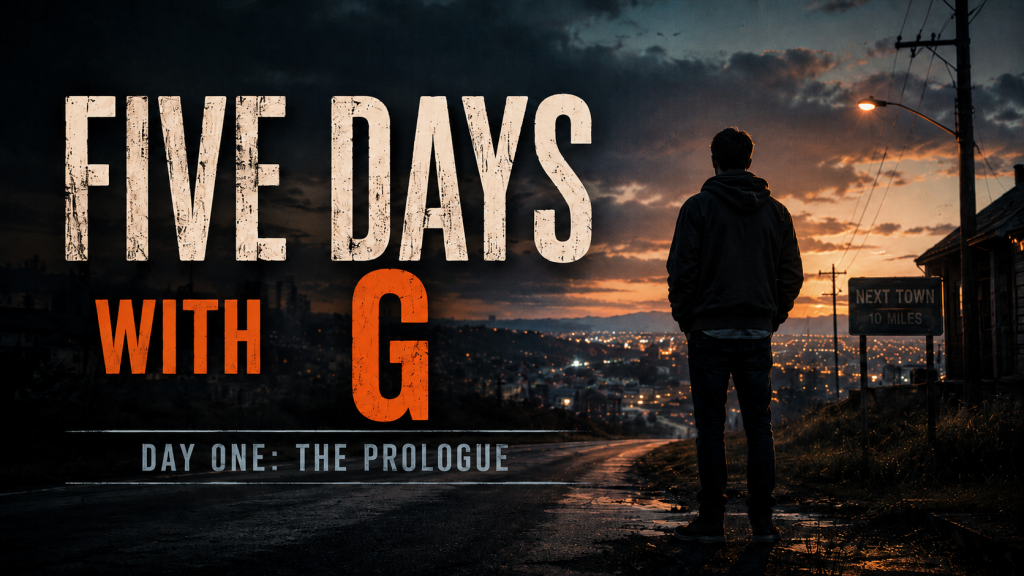
This story follows three people—G, Ray, and Jimmy—and examines their relationship across five specific days. Those days are separated by decades, allowing us to see not only how the characters change, but how the world around them changes.
The first day takes place roughly thirty years ago, as they are graduating from high school.
This was before everybody carried a cellphone. Schools had security systems, but they were often primitive. They might have motion sensors in the main offices or along the long exterior hallways, while nobody thought very carefully about interior doors, drainage systems, maintenance access, or all the other forgotten spaces built into the property.
The story begins with Ray approaching G, who is sitting by himself reading Friedrich Nietzsche’s The Will to Power.
Ray looks at the book and says:
“You only survived two months of German. You don’t speak it. Why are you reading it?”
G answers:
“Speaking is overrated. Understanding is what’s needed.”
That line tells us a great deal about G. He is not interested in performing intelligence for other people. He is interested in understanding how things work.
Jimmy then approaches them, looking for an envelope.
G hands it to him.
Jimmy asks, “Where’s my cut?”
G visibly winces before answering:
“That’s between you and your father. That’s not our arrangement.”
Ray, who has not been paying attention to any of the tension, suddenly says:
“Pooper Scooper! What are your plans for tonight?”
Jimmy looks at him and says:
“Stop calling me that.”
Then he looks back at G.
“We’ll see about that.”
G winces again and simply says:
“Okay.”
Jimmy storms away.
G then turns to Ray and tells him to meet him later that night in the field behind the school.
Ray asks why.
G says:
“I’ll give you the entire paycheck from this job if you show up.”
That evening, Ray meets G in the field overlooking the high school.
G studies the building and says:
“Yep. Just like I thought.”
Ray asks what he means.
G points toward the school.
“Jimmy’s father has two patrol cars outside.”
“What the hell are they doing there?”
“Jimmy’s father is getting a search warrant. Let’s go.”
Ray assumes they are leaving.
G tells him:
“No. Follow me.”
They begin crossing the field, heading down a hill and into a swampy area. G leads Ray toward a drainage pipe running underneath the school property.
Ray looks at the pipe, then at G.
“What the fuck are we doing down here?”
“We’re going into the school.”
And Ray asks the completely reasonable question:
“Dude, is this going to be felonies?”
That is where the real game begins.
Because Ray thinks the danger is breaking into the school.
Jimmy thinks the danger is whatever his father is investigating.
The police think the danger is whatever they expect to find when they execute the warrant.
But G has already realized that everybody is playing the wrong game.
At this point in the livestream, there is another layer to what is happening.
I am explaining a story while ChatGPT monitors and organizes my speech in real time. It is not inventing the core story for me. This story has been sitting in my head for decades. What the AI is doing is taking the way my brain delivers information—side comments, technical observations, historical context, jokes and all—and turning it into something another person can follow.
Because even I recognize that not every level of my thought process needs to be expressed simultaneously to everyone, including myself.
So, the adventure continues.
G and Ray travel through an old drainage route and eventually emerge through the swimming-pool maintenance system inside the school.
Could somebody realistically enter a school that way?
Probably not.
It is a fictional device that gets the characters into the building. This is a story, not an architectural manual. Although those of us who attended school in that era may remember being told to crawl through pipes, climb walls and drag ourselves through obstacle courses under the respectable title of “Project Adventure.”
Once inside, G hands Ray a pair of gloves and begins putting on his own.
Ray looks confused.
“Dude, our fingerprints are already everywhere in this school. Why do we need gloves?”
G answers:
“We’re not going anywhere we usually go.”
He then reminds Ray not to touch any exterior doors or go near the normal entrances.
Ray notices the keys in G’s hand.
“What are those?”
“Janitor’s keys.”
“What the hell?”
G removes a notebook and starts reading from a list.
“We’ll start with the English department. Then music. Then the gym.”
Ray looks at the length of the list.
“This is a lot of shit.”
G hands him a bag.
“Everything goes into this. Everything is leaving.”
A song like “Dirty Deeds Done Dirt Cheap” could be playing over the sequence as they move through the building.
Room by room, office by office and hiding place by hiding place, they begin collecting the illicit stashes hidden throughout the school.
The point is not that every teacher or employee has something concealed. The point is that institutions are filled with private habits, compromises and secrets. Some people bring the bad habits they learned in college into their professional lives. Others become perfectly functional addicts whose behavior remains invisible because they still arrive at work and complete their responsibilities.
By the time G and Ray are nearly finished, the bag has developed considerable weight.
Ray looks through what they have collected.
“Holy shit. I didn’t know she was on Quaaludes.”
G suddenly stops.
He takes one particular packet from the bag.
“I’ll be right back.”
He walks to a locker, opens it, places the packet deep inside and closes the door.
Ray watches him.
“What was that?”
“We’re removing everything.”
“Then why did you put that back?”
G looks at the locker.
“That’s insurance.”
They return toward the pool area.
Before leaving, G tells Ray:
“Dump the drugs.”
Ray stares at him.
“What?”
“Dump them.”
“Dude, there’s money here.”
“No. There are problems here. Dump them.”
Ray hesitates. He does not entirely understand G’s reasoning, but he understands that G is not negotiating.
He empties the contents where they will be destroyed and carried away.
G activates the fictional maintenance system, sending a heavy rush of water through the old drainage route. Whatever had been discarded disappears with it.
Then G shuts the system down and restores everything to the way they found it.
For a moment, both boys watch the last of the water disappear.
They climb back into the passage, crawl through the tunnel and emerge outside.
Then they separate and head home as though nothing happened.
Ray believes they have just removed a collection of drugs from the school.
The police believe they are preparing to search for evidence.
Jimmy believes he is about to force G into honoring an arrangement that never existed.
But G has done something more calculated.
He has removed the evidence everyone expected to find, destroyed anything that could be sold or recovered, and preserved one carefully selected piece as insurance.
And once again, everybody involved believes they understand the game.
They do not.
The story now moves forward several hours.
The next time we see G and Ray, they are meeting at a diner.
G enters carrying two identical backpacks.
Ray is already waiting for him.
The moment G sits down, Ray leans across the table.
“Dude, did you hear?”
“Yes. I heard.”
“They found fucking coke in Jimmy’s locker.”
G remains calm.
Ray stares at him as the realization settles in.
“That’s what you did.”
“Yeah. That’s what I did.”
Ray looks around the diner, suddenly nervous.
“I’ve got to get out of town.”
G reaches beneath the table and lifts one of the backpacks onto Ray’s side.
“No. I promised you the entire paycheck for that job.”
He slides the backpack toward him.
“As promised, that’s your pay.”
Then G gives him a piece of advice.
“Now I suggest you take a vacation.”
Ray looks at him.
“What?”
“Get out of here for a while.”
“Why?”
G glances around the diner.
“I’m leaving. I can’t stay around here.”
Ray lowers his voice.
“What? Is this coming down?”
“I’m radioactive.”
G pauses.
“You could possibly be radioactive.”
Ray is still trying to understand what G means, what has happened and how much danger they might actually be in.
G stands.
“Look, I’ve got to go. Have yourself a good one. I just can’t be around here, okay?”
Ray watches him leave with the second backpack.
Then he slowly opens the backpack G left behind.
Inside is fifty thousand dollars.
Ray stares at the money.
And then an alarm begins ringing.
The diner disappears.
We are no longer thirty years in the past.
We are in the present day.
Ray is lying in bed, waking to his phone.
Marty is calling.
Ray answers, still disoriented from the dream or memory.
Marty tells him he needs to be at the pickup location in fifteen minutes.
And that ends the introduction.
In one opening sequence, we have established the three central characters, their relationships and the event that separated them.
Jimmy believes G betrayed him.
Ray knows G planted the evidence, but he does not yet understand the entire plan.
G has disappeared with another backpack and declared himself radioactive.
Then, thirty years later, Ray wakes up and is immediately pulled into whatever is about to happen next.
That is how the story moves from the old game into the wrong game.
And presenting this live is interesting because it also demonstrates how stories are built.
I am speaking through an idea that has existed in my head for roughly thirty years. The AI is helping organize that spoken material into a form that other people can follow. It is taking the fragments, dialogue, explanations and side observations and revealing the structure already underneath them.
Even this opening segment has its own complete story arc.
We begin with three high-school students.
We introduce a hidden agreement.
We learn that the police are preparing to search the school.
G and Ray enter the building and remove the evidence.
G secretly plants one item in Jimmy’s locker.
Ray receives fifty thousand dollars.
G disappears.
Then the alarm rings, and we discover that the entire sequence is being remembered—or dreamed—by the adult Ray thirty years later.
That is the hook.
The audience now wants to know where the money came from, what Jimmy and his father were involved in, why G considered himself radioactive, what was inside the second backpack and why these three people are being brought back together after three decades.
That is how you build a story, folks.