
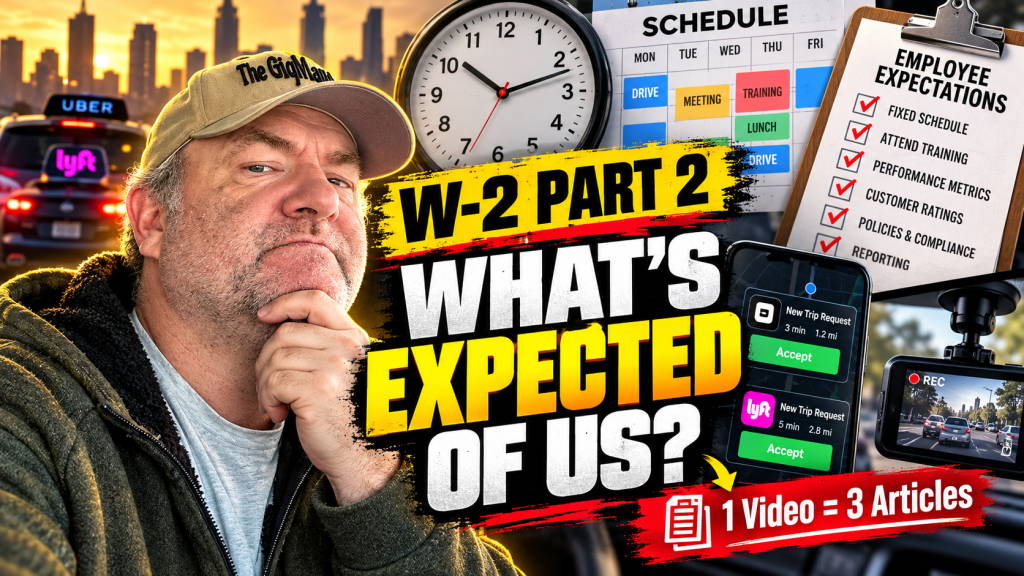
I didn’t exactly plan on getting three articles out of one video.
But every time I go back through the argument about making rideshare drivers W-2 employees, another question pops up that nobody seems to be answering.
Part One was basically:
What exactly is becoming W-2 supposed to fix?
Now we’re onto Part Two:
Okay. If I’m your employee, what exactly are you going to expect from me?
Because this conversation keeps getting presented as though we’re going to take the rideshare system we have right now, change the tax classification, throw in some employee protections and benefits, and everything else will continue exactly the same.
I don’t think you can assume that.
And some of the examples used in the video actually demonstrate why.
Picking Your Schedule Isn’t Making Your Schedule
One example was essentially:
“My wife is a nurse, and she gets to make her own schedule.”
Okay.
Let’s be very clear about something.
Picking your schedule and making your schedule are not the same thing.
If a hospital says:
“We need people working these shifts. Here are the available blocks. Which ones do you want?”
You’re picking a schedule.
That can still be excellent flexibility.
I’m not saying it isn’t.
But the employer created the available times.
The employer decided when staffing was required.
The employee selected from those available choices.
That is considerably different from what I can do right now as a rideshare driver.
If it’s 9:17 in the morning and I suddenly decide:
I want to work.
I turn the app on.
If it’s 11:43 and I decide:
This sucks. I’m going home.
I turn it off.
I didn’t request permission.
I didn’t trade shifts with another driver.
I didn’t see whether there was an available block.
I didn’t ask my supervisor whether I could leave early.
I simply stopped working.
And if Saturday morning comes around and I had planned to stay home but suddenly decide I want to drive?
I turn the app on.
That’s much closer to actually making my own schedule.
During the discussion, the argument eventually shifts into acknowledging that drivers might have to pick certain hours or blocks.
Well, yes.
And that’s precisely the distinction I’m making.
If I have to choose from employer-created work blocks, that is a material change in how this job operates.
Maybe some drivers would prefer that.
Fine.
But don’t tell me nothing has changed.
Then There’s the Police Officer Example
Another comparison was essentially that police officers can sit around while nothing is happening and still get paid.
Well, yes.
Because waiting is part of their job.
Watching an area is part of the job.
Patrolling is part of the job.
Being available when something happens is part of the job.
We’re not living in the Wild West where the sheriff only gets paid when somebody brings in a horse thief.
A modern police officer doesn’t stop being at work because nobody is currently committing a crime in front of them.
They’re being paid to be available.
And that’s where this comparison creates a question that actually works against the argument being made.
If you want to compare a rideshare driver waiting for a passenger to a police officer waiting for a call, then we have to talk about what happens when that waiting time becomes paid working time.
Because if you’re paying me for that time?
You’re also my employer during that time.
And employers tend to have expectations about what employees do while they’re on the clock.
“Maybe You Want to Go Shopping”
This was another part of the discussion.
Maybe you’re waiting for a trip.
Maybe you want to watch YouTube.
Maybe you want to go shopping.
Maybe you want to do something else while you’re waiting.
Right now?
Sure.
That’s part of the independence I have.
If I’m sitting somewhere and nothing useful is happening, I can decide I’m going to get lunch.
I can stop at a store.
I can watch something.
I can relocate.
I can sit there.
I can decide the entire market sucks and go home.
That’s because I’m not being paid an hourly wage to remain available to an employer.
Now let’s change the arrangement.
You’re paying me from 9:00 until 5:00.
Okay.
What am I allowed to do during those eight hours?
Can I go grocery shopping for forty-five minutes?
Can I drive twenty minutes away because I want coffee?
Can I park somewhere and watch YouTube while ride requests are coming in?
Can I decide at noon that I’ve had enough and go home?
Maybe.
But now I want to see the policy.
Because I’ve worked jobs where waiting was part of the job.
Security is a perfect example.
There were plenty of times when absolutely nothing happened.
That’s good.
In security, a boring shift can be a very successful shift.
But if I was being paid to watch a building, I couldn’t say:
“Well, nothing has happened in the last half-hour. I’m going to Walmart.”
I was still at work.
That time didn’t suddenly become mine because nobody was kicking down a door.
And that’s the distinction that gets lost when somebody says:
“Well, as an employee you’d get paid while waiting.”
Great.
What do you expect from me while I’m waiting?
That’s the other half of that sentence.
What Happens to Trip Acceptance?
Here’s another one.
I’m now your employee.
I’m scheduled from 9:00 until 5:00.
You offer me a trip.
I decline it.
You offer another.
I decline that one too.
Then another.
No.
Another.
No.
At what point does my employer ask:
What exactly are we paying you to do?
That’s not an unreasonable question for an employer to ask.
Which means acceptance rates suddenly become a much more interesting subject.
Right now, drivers argue constantly about acceptance rates.
People decline rides for all kinds of reasons.
Pickup distance.
Destination.
Traffic.
Pay.
Neighborhood.
Length of trip.
Whether they want to end up forty miles from home.
Whether they simply don’t want that ride.
Now imagine an actual employment relationship.
Does the employer establish a minimum acceptance percentage?
Do repeated refusals become a performance issue?
Is there progressive discipline?
Do you get written up?
Does refusing assignments eventually become insubordination?
I don’t know.
That’s why I’m asking.
Show me the policy.
And What About Cancellations?
The same thing applies to cancellations.
Right now, a driver can accept a trip, see something that changes the situation and cancel.
Maybe the passenger messages something inappropriate.
Maybe the pickup becomes unsafe.
Maybe the trip isn’t what the driver thought it was.
Maybe there’s a child without a proper restraint.
Maybe something simply feels wrong.
As an employee, what counts as an acceptable cancellation?
How many cancellations are permitted?
What documentation is required?
Does a supervisor review them?
Are certain cancellation reasons considered valid and others considered performance problems?
Again:
I don’t know.
Neither does somebody simply saying:
“W-2 would be better.”
Because we haven’t seen the employment policy.
Where Are You Allowed to Work?
Here’s another question nobody seems to talk about.
If I’m an employee being paid for my time, can the company tell me where I need to be?
Right now, if I don’t like one market, I leave.
I can drive toward another city.
I can avoid college areas late at night.
I can decide traffic somewhere isn’t worth dealing with.
I can choose where I want to position myself.
Would that continue under an employee model?
Or does the company eventually say:
“We need you in this zone.”
“Demand is high here.”
“Remain within this area.”
“Do not leave the service region during your scheduled block.”
Again, maybe they wouldn’t.
But an employer directing employees toward where work needs to be performed isn’t some outrageous concept.
That’s what employers do.
Which is why the question isn’t:
Could W-2 rideshare still be flexible?
Of course it could.
The question is:
How flexible would the actual employment agreement make it?
What Happens When You Want to Stop?
This is one of the biggest differences for me.
Right now, if I decide I’m done for the day, I’m done.
That’s it.
I go home.
What happens if I’m scheduled as an employee until 5:00?
Can I leave at 2:30 because business is slow?
Can I say I made enough money today and I’m finished?
Can I log out because traffic has become ridiculous?
Can I decide I just don’t feel like doing another three hours?
Or is that leaving work early?
That’s not a trick question.
That’s the kind of thing employees normally have policies about.
Attendance.
Tardiness.
Leaving early.
Absences.
Call-outs.
Schedule adherence.
Again, none of those things are inherently evil.
They’re part of employment.
That’s precisely my point.
You don’t get to advertise all of the benefits of becoming an employee while pretending none of the obligations of employment come with it.
And Yes, Employment Can End Too
Then we get into another subject people don’t like talking about.
Performance.
Suppose I’m now an employee.
My acceptance rate isn’t good enough.
My cancellations are too high.
I’ve left early too many times.
I’m not working enough scheduled hours.
I keep refusing certain assignments.
I’m outside my assigned area.
I’m taking too many personal breaks.
At some point, the company can decide that I’m not meeting its expectations.
Warnings.
Performance plans.
Suspensions.
Termination.
And in many employment relationships, particularly where employment is at-will, the employer has substantial ability to end that relationship for lawful reasons.
Again, that’s not me saying employment is terrible.
That’s me saying:
It’s employment.
There are benefits.
There are protections.
There are also rules.
You Can’t Have Both Arguments at the Same Time
This is where I think the W-2 sales pitch starts contradicting itself.
On one side:
“You’ll get paid for waiting.”
Okay.
Then what am I required to do while I’m waiting?
“You’ll still have flexibility.”
Okay.
Can I start whenever I want?
“Well, you might have to choose blocks.”
Then I’m picking my schedule, not making it.
“You’ll still be able to reject rides.”
Okay.
How many?
“You’ll still be able to cancel.”
Under what circumstances?
“You could still watch YouTube while waiting.”
Maybe.
Can I ignore assignments while I do it?
“You can still go shopping.”
During paid working hours?
For how long?
Do I have to clock out?
“You’ll get paid like other employees.”
Fine.
Then don’t act surprised when I start asking about all of the other things that normally come with being an employee.
Because that’s the discussion we actually need to have.
Show Me What the Job Looks Like
I’m not asking these questions because I’m terrified of W-2 employment.
I’ve been an employee.
I’ve worked under corporate policies.
I’ve worked jobs where I had assigned responsibilities, schedules, confidentiality rules and expectations about what I could and couldn’t do while being paid.
That’s exactly why I’m asking.
If you’re proposing converting rideshare drivers from independent contractors into employees, show me what that job actually looks like.
Show me the scheduling policy.
Show me the attendance policy.
Show me what counts as working time.
Show me the break policy.
Show me whether I can leave early.
Show me whether I can start late.
Show me whether I can work whenever I want.
Show me the acceptance requirements.
Show me the cancellation rules.
Show me the service-area requirements.
Show me the performance standards.
Show me the disciplinary procedure.
Then we can actually compare the two systems.
Because until then, all we’re doing is comparing the current reality of independent contracting against somebody’s imaginary version of employment where apparently every employee benefit gets added while every bit of contractor independence remains untouched.
That’s not a serious comparison.
And Then There Are My Cameras
And here’s one last example before we get into Part Three.
I have security cameras in my car.
They’re mine.
I bought them.
I installed them.
I maintain them.
And I keep my own footage because I want an independent record of what happens inside my vehicle.
If something happens during a ride and video is relevant, I can provide it.
Fine.
But now make me an employee.
What happens if recording becomes part of the job?
What happens if company policy says that when an investigation occurs, I am required to submit footage?
What happens if they establish retention requirements?
Thirty days.
Sixty days.
Ninety days.
What happens if they specify what camera I’m required to use?
What happens if they provide the camera?
What happens if an investigator says:
“We need everything recorded between 2:00 and 5:00 that afternoon.”
And then we get to the really interesting question:
Whose footage is it?
Is it still my private security footage that I happen to provide when necessary?
Or is it now a business record created while I was performing work for my employer?
Can the company require a copy?
Can it require the original?
Can it tell me how long to keep it?
Can it tell me when I have to destroy it?
Can it tell me whether I’m allowed to retain my own copy?
I don’t know.
Which means—
show me the policy.
And that’s where this accidentally becomes a trilogy.
Because Part One was:
What exactly does W-2 fix?
Part Two became:
What exactly are you going to expect from me once I’m your employee?
And now there’s another pile of questions sitting there.
Because cameras aren’t the only things drivers create or produce while doing this work.
Some drivers make videos.
Some write articles.
Some write software.
Some develop training systems.
Some design equipment.
Some invent things.
Some build entire businesses based around knowledge they’ve gained while doing rideshare.
And once you become an employee, there’s another set of documents I want to see.
The work-product agreement.
The intellectual-property agreement.
The confidentiality agreement.
The social-media policy.
The outside-business policy.
Because Part Two was about:
What are you going to require me to do because I’m your employee?
Part Three is going to be:
What are you going to claim belongs to you because I’m your employee?
All from one video.
Apparently I should thank RideShare Pro for the trilogy.