
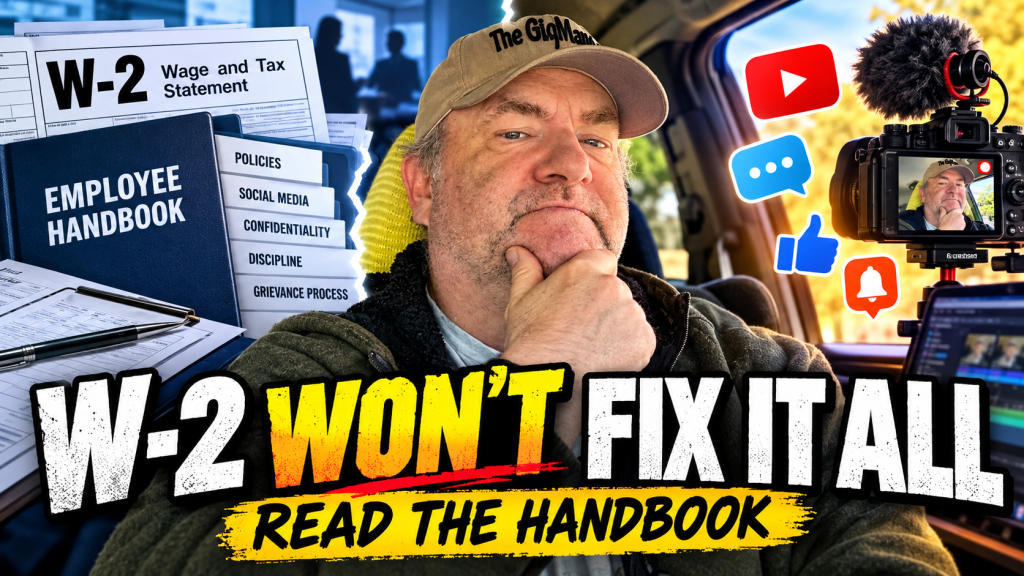
There is one more part of this W-2 conversation that probably deserves its own article.
And before going any further, I want to make something clear.
This is not an argument that W-2 employment is bad.
It is also not an argument that independent-contractor status is automatically better.
That has never really been the point of these articles.
The point is that when somebody says:
“Just make drivers W-2 employees. That will fix everything.”
My response is:
Okay. Then let’s actually talk about what that means.
Because changing employment classification does considerably more than change how taxes are withheld or whether somebody gets certain benefits.
It changes the relationship between the worker and the company.
And if the worker also happens to be a creator who publicly discusses that company, there is another entire part of that relationship that deserves some attention.
Because I am not just a rideshare driver.
I am also a creator.
I talk about this industry. I talk about Uber. I talk about Lyft. I talk about policies I agree with, policies I disagree with, things that happen during my day, changes to the apps, safety issues, compensation, and the general insanity that comes with doing gig work.
Right now, there is a very important distinction in that relationship:
I am not their employee.
So what happens if that changes?
This Isn’t About One Side Being Better
This is where these conversations tend to go wrong.
People immediately want to turn the classification debate into:
W-2 good. Independent contractor bad.
Or:
Independent contractor good. W-2 bad.
I’m not interested in reducing it to that.
Both structures have advantages.
Both structures have disadvantages.
Both structures come with rights, responsibilities, restrictions and tradeoffs.
If we’re seriously discussing changing an entire workforce from one structure to another, then we should probably discuss all of those things instead of picking the three benefits we like and pretending nothing else changes.
And one of those changes could involve what happens when an employee publicly discusses the company.
Welcome to the Employee Handbook
One of the arguments you constantly hear is:
“Well, they can’t fire me just for expressing myself.”
The situation is considerably more complicated than that.
Once you become an employee, there may be an employee handbook.
There may be a social-media policy.
There may be a confidentiality policy.
There may be rules governing contact with the media.
There may be rules governing the use of company names, logos, internal communications, customer information, screenshots, recordings and information obtained while performing your job.
There may also be formal procedures governing how workplace grievances are supposed to be reported.
Again, that isn’t necessarily bad.
A company having established procedures for reporting safety problems, harassment, payroll issues or other grievances can actually be beneficial.
The question is whether anybody talking about W-2 classification has considered that those procedures become part of the relationship too.
Imagine that you’re a YouTube creator.
You get angry about something that happened during work.
You go home.
You turn on the camera.
And you spend 20 minutes talking about the company.
The next conversation might not simply be:
“Was Christopher right?”
It could become:
“Did Christopher comply with the policies governing employees?”
That’s a very different question.
“Did You Report It?”
And this is where one of my favorite subjects comes back again:
Documentation.
Suppose I make a video saying:
“I’ve been telling the company about this safety problem for months and they haven’t done anything.”
Okay.
Can I prove that?
Who did I tell?
When did I tell them?
Did I submit a support ticket?
Did I email somebody?
Do I have the response?
Did I use whatever internal reporting procedure existed?
Did they close the complaint?
Did they tell me the issue was being investigated?
Suddenly that collection of screenshots, emails, support conversations and case numbers becomes extremely important.
Because if the company says:
“He never brought this to our attention.”
I want to be able to say:
Really? Here’s ticket number one. Here’s ticket number two. Here’s the email. Here’s your response. And here’s the date.
That’s considerably stronger than:
“I know I complained about it sometime last year.”
The Company Doesn’t Get Unlimited Control Either
There is another side to this.
Being an employee does not automatically mean surrendering every right to discuss your workplace.
Employees can have legal protections involving discussions of wages, safety, working conditions and collective workplace concerns.
Whistleblower protections may apply in certain circumstances.
Anti-retaliation laws may apply.
Other employment protections may apply depending upon exactly what happened.
So this isn’t:
“Become W-2 and the company can silence you.”
That would be just as simplistic as saying:
“Become W-2 and all your problems disappear.”
The reality lives somewhere in the details.
A company’s legitimate confidentiality policy is one thing.
An employee discussing wages or working conditions may be another.
An employee revealing protected customer information is another.
An employee making allegations about safety conditions may create yet another set of questions.
And an employee simply going online and attacking the company over an individual disagreement could be another situation entirely.
That’s exactly why this discussion matters.
Creator Christopher and Employee Christopher
This becomes particularly interesting for somebody like me.
Imagine there are now two Christophers.
There is Christopher the employee, operating under whatever employment agreement, handbook and workplace policies exist.
Then there is Christopher the creator, whose platform includes talking about the rideshare industry.
Where does one stop and the other begin?
If I discuss publicly available changes to the Uber app, that’s one thing.
If I discuss my personal experience driving, that’s another.
If I show an internal employee communication marked confidential, now we’re somewhere else.
If I show video from inside my vehicle involving a customer, there may be privacy and company-policy questions.
If I discuss compensation and other drivers become involved in that conversation, labor protections may become relevant.
Those distinctions barely get mentioned when somebody says:
“Just make drivers employees.”
It’s treated like the only thing that changes is a box on the tax form.
It isn’t.
The relationship changes.
This Goes Back to Work Product Too
This is why this article belongs alongside the other pieces about W-2 employment and work product.
We already talked about the question:
Who owns what you create while you’re working?
But there is another question sitting right beside it:
What are you allowed to do publicly with information you acquire through your employment?
Those are related questions, but they’re not identical.
And for creators, journalists, bloggers, streamers, TikTok creators, YouTubers or anybody else who publicly discusses their job, that distinction can matter considerably.
A person can spend years building a channel around gig work and then discover that changing the legal relationship between the driver and the platform also changes the relationship between the driver and that channel.
That doesn’t necessarily make the new relationship worse.
It makes it different.
And different means it deserves discussion before somebody declares the problem solved.
Keep Your Receipts
Which brings me right back to documentation.
If you are raising a legitimate problem with a company, document it.
If you send the company something, keep it.
If they respond, keep that.
If there is a policy governing what you are supposed to do, keep a copy of the policy that existed at that time.
If they change the policy later, keep both versions.
Because if somebody eventually asks:
“Did you give the company an opportunity to address this?”
you don’t want your answer to depend entirely upon memory.
You want dates.
You want case numbers.
You want emails.
You want screenshots.
You want the actual paper trail.
And interestingly enough, the more formal the employment relationship becomes, the more important that paper trail can become.
W-2 Is Not a Magic Button
This is really the point behind this entire series.
I’m not saying W-2 employment is bad.
I’m not saying independent-contractor status is good.
I’m saying that “W-2 will fix everything” is not a serious analysis of the problem.
Employment classification touches compensation.
Taxes.
Scheduling.
Supervision.
Discipline.
Benefits.
Expenses.
Intellectual property.
Work product.
Confidentiality.
Public communications.
Workplace protections.
And potentially the separation between what you do for a living and what you discuss publicly as a creator.
Some of those changes may benefit drivers.
Some may benefit the company.
Some may create additional protections.
Some may create additional restrictions.
And some may simply create an entirely new category of arguments that doesn’t exist in quite the same form today.
That’s what should actually be discussed.
If somebody believes W-2 classification is the better structure, fine.
Explain why.
Explain what drivers gain.
Explain what drivers give up.
Explain what control the company gains.
Explain what protections the employees gain.
Explain what happens to scheduling.
Explain what happens to expenses.
Explain what happens to work product.
Explain what happens when the driver publicly criticizes the company.
Then we can actually have the conversation.
Because changing millions of workers from independent contractors to employees is not flipping a switch labeled:
BENEFITS: ON.
It’s changing an entire relationship.
And before anybody tells me that W-2 employment will solve everything, I would really like to know whether they’ve bothered reading the rest of the employee handbook.