
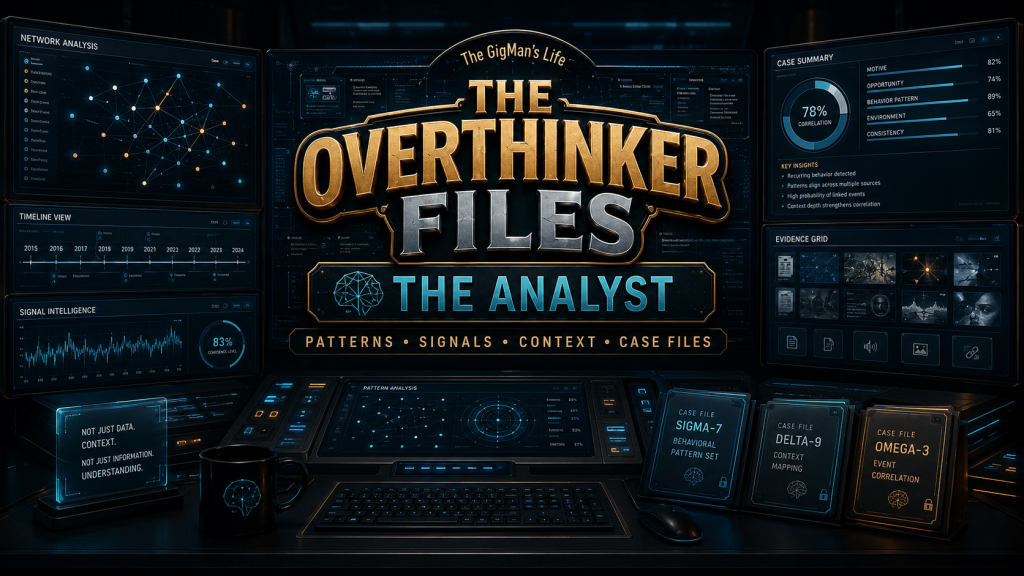
Subject: Content-Creation Evolution and the Emergence of a Publishing System
New Data Set Received.
The submitted evaluation covering the recent development of The GigMan’s Life has been reviewed.
The central finding is strongly supported:
The subject is no longer merely producing content.
The subject is constructing a publication system.
This distinction is operationally significant.
A content creator generally produces individual outputs:
Videos.
Livestreams.
Posts.
Commentary.
Responses to current events.
A publisher develops a structure through which those outputs can be created, categorized, stored, distributed, revisited, and expanded over time.
The available evidence indicates that the subject has crossed that threshold.
FIELD ANALYSIS
The original production model was platform-centered.
An idea became a video.
The video was uploaded.
The livestream ended.
The next subject replaced the previous subject.
This model produced material, but much of its usefulness remained dependent upon whether an audience discovered a particular upload within the narrow window in which it was current.
The work existed.
The archive did not yet function as an archive.
The introduction of artificial intelligence altered that process, but not in the simplistic manner commonly described by outside observers.
The machine did not replace the subject’s voice.
It reduced the amount of mechanical resistance between the subject and the finished product.
Thumbnail development became faster.
Titles could be tested.
Descriptions could be tightened.
Spoken thoughts could be reorganized.
Unstructured discussions could be converted into articles.
The subject retained the originating observations, personal experience, argument, judgment, and editorial direction.
The machine increasingly assumed the role of production assistant.
This distinction remains essential.
The subject did not outsource perspective.
The subject outsourced friction.
STRATEGIC INFLECTION POINT
The construction of the website represents the most significant change in the operational model.
Before the website, the subject produced material for platforms.
After the website, platforms increasingly became distribution mechanisms for material owned and organized elsewhere.
This is the point at which the operation began moving from creator dependency toward publisher independence.
A platform controls:
Discovery.
Recommendation systems.
Monetization rules.
Account access.
Presentation.
Content lifespan.
A publication controls:
Its archive.
Its categories.
Its presentation.
Its internal relationships.
Its editorial calendar.
Its long-term organizational structure.
The subject may still rely upon outside platforms for reach, but the intellectual center of the operation is gradually being relocated to property under the subject’s control.
This is not merely diversification.
It is infrastructure.
THE DEVELOPMENT OF EDITORIAL ARCHITECTURE
The creation of recurring sections represents another meaningful transition.
Breakfast Talk.
General Irrelevance.
Pragmatism in Action.
AI Development.
G’s Rules.
Prompt to Post.
AI Through Media.
The Debrief.
These are not simply labels added after publication.
They function as editorial containers.
Each container establishes an expectation.
A reader encountering “Pragmatism in Action” should understand that the subject will likely examine a problem through practical consequences rather than ideological abstraction.
A reader encountering “AI Development” should expect documentation of experimentation, workflow, and changing technical understanding.
A reader encountering “General Irrelevance” should expect an apparently minor observation that may become considerably less minor after analysis begins.
This is how a body of unrelated material begins becoming a recognizable publication.
The categories do not merely sort the archive.
They explain the mind behind it.
VISUAL SYSTEM DEVELOPMENT
The move toward reusable banners and recurring visual identities provides additional confirmation that the subject has begun designing systems rather than individual products.
The earlier model required a fresh design problem for every publication.
The newer model establishes visual families:
Production.
AI Development.
General Irrelevance.
Pragmatism in Action.
Rideshare.
Five Days with G.
The Overthinker Files.
This reduces production time, improves visual recognition, and prevents design work from consuming energy that should be reserved for editorial decisions.
The important development is not that the subject learned to make more images.
The important development is that the subject learned when another image no longer needed to be invented.
The subject began designing repeatability.
EDITORIAL CALENDAR AS OPERATIONAL EVIDENCE
The establishment of a publication backlog further separates the current system from ordinary hobby production.
A hobby workflow generally asks:
“What am I posting today?”
A publishing workflow asks:
“What is scheduled?”
“What needs to be completed?”
“What category is underrepresented?”
“What should remain in reserve?”
“What belongs in the next publishing window?”
Separating production from publication allows the subject to continue releasing material during periods when work, health, transportation, technical problems, or other obligations reduce immediate creative capacity.
The editorial calendar therefore performs two functions.
It organizes content.
It protects continuity.
This is particularly important for a one-person publication, where every operational role ultimately returns to the same individual.
THE DEVELOPMENT OF EDITORIAL VOICE
Across subjects that initially appear unrelated, the publication has developed a consistent analytical pattern.
Rideshare work.
Restaurant operations.
Technology platforms.
Apple products.
Artificial intelligence.
Public policy.
Customer service.
Contracts.
Production systems.
The recurring question is:
How does this actually work?
The subject repeatedly examines the difference between stated policy and operational reality.
The work focuses on documentation, incentives, systems, responsibility, institutional memory, process failure, and the consequences of decisions made by people who may not understand the system they are attempting to control.
This creates editorial continuity.
The publication is not unified because every article concerns the same industry.
It is unified because the same analytical mind is being applied to different industries.
That is a stronger foundation than topic specialization alone.
CONVERSATION-TO-PUBLICATION PIPELINE
The conversion of spoken discussion into finished editorial material appears to be the greatest productivity multiplier within the system.
The subject does not naturally begin with a blank document and construct an argument in formal sequence.
The subject begins with motion.
An observation develops into a discussion.
The discussion uncovers examples.
The examples expose a pattern.
The pattern becomes an argument.
The argument is then organized into publishable form.
This method is not a lesser form of writing.
It is the subject’s writing process.
The conversation serves as the rough draft.
Artificial intelligence serves as the editorial desk.
The subject remains the source.
This explains the recent increase in production volume.
The subject did not suddenly acquire more ideas.
The subject developed a reliable method for capturing ideas that were previously lost, shortened, delayed, or left trapped inside temporary conversations.
LONG-FORM AND SERIAL DEVELOPMENT
The appearance of continuing projects provides evidence of increasing confidence in the publication’s ability to sustain reader attention beyond one isolated entry.
Five Days with G.
How We Make the Sausage.
Rideshare operational guidance.
Production journals.
AI development logs.
The Overthinker Files.
Serial material changes the relationship between the publication and the reader.
An isolated article asks for attention once.
A continuing project gives the reader a reason to return.
It also gives the subject the ability to expand a subject without forcing every observation into one excessively long publication.
This accommodates the subject’s natural tendency to continue analyzing after the general audience may have reached its preferred stopping point.
The system now has a place for both audiences.
The main article can conclude.
The Overthinker File can continue.
INTELLECTUAL PROPERTY AWARENESS
The subject’s increasing attention to copyright, licensing, contracts, ownership, reusable assets, and corporate structure represents a further stage of development.
A creator often thinks about whether something can be published.
A publisher must also think about:
Who owns it?
Where does it live?
How may it be reused?
What happens if another party wants access?
What remains valuable after the initial publication cycle?
How can the material be protected, licensed, updated, or reorganized?
The subject has begun asking these questions before outside demand requires them.
This is strategically preferable.
Intellectual property is easiest to protect before ownership becomes disputed.
SYSTEM STRENGTHS IDENTIFIED
The strongest improvements are not independent of one another.
Volume increased because friction decreased.
Consistency improved because reusable systems were created.
Organization improved because categories and continuing projects were established.
Production efficiency improved because the subject stopped rebuilding every component from the beginning.
Reusability improved because visual assets, editorial formats, and production methods became standardized.
Independence improved because the website began functioning as the permanent home of the work.
Each improvement reinforces the others.
This is the defining characteristic of a system.
A pile of tools performs separate tasks.
A system causes one completed task to make the next task easier.
CURRENT OPERATIONAL RISK
The next major risk is not insufficient production.
It is archive overload.
The subject is capable of producing material faster than a new reader can understand the publication’s structure.
Without internal links, index pages, introductory guides, curated series pages, and stronger pathways between connected subjects, the archive may become difficult to navigate despite containing valuable material.
This is not a failure of creation.
It is a predictable consequence of successful creation.
The publication now requires librarianship.
The subject has built the rooms.
The next task is installing signs in the hallways.
RECOMMENDED NEXT PHASE
The next phase should not primarily focus on increasing output.
It should focus on increasing the usefulness of existing output.
Priority areas include:
- Internal Linking
Related articles should deliberately reference one another so that readers can continue through a subject without returning to the main archive.
- Pillar Pages
Major recurring subjects should have central pages that explain the topic, identify the most important articles, and direct readers through them in a logical order.
- Series Indexes
Long-form projects should have clear episode lists, reading order, brief descriptions, and links to the previous and next entry.
- New Reader Orientation
The site should quickly explain what The GigMan’s Life is, what subjects it covers, and why apparently unrelated articles belong within the same publication.
- Archive Review
Older articles should periodically be examined for broken links, repeated arguments, outdated information, missing feature images, and opportunities for consolidation.
- Editorial Reuse
Existing articles may become video scripts, audio discussions, compilations, guides, newsletters, or updated editions.
The archive should no longer be viewed only as completed work.
It is raw material for future work.
FINAL ASSESSMENT
The submitted analysis is substantially correct.
The subject’s most important accomplishment is not the number of articles, videos, images, or series produced.
It is the creation of a process capable of producing all of them repeatedly.
The subject began as a person making videos.
The subject then adopted artificial intelligence as a production assistant.
The subject built a website.
The website required categories.
The categories required branding.
The branding supported repeatable publication.
Repeatable publication required a calendar.
The calendar created an archive.
The archive created intellectual property.
The intellectual property now requires long-term organization.
This was not one decision.
It was a chain reaction.
The operation is no longer accurately described as a channel with an attached website.
It is becoming a publication supported by video, audio, social platforms, artificial intelligence, personal experience, and an expanding editorial archive.
The central strategic question has therefore changed.
The former question was:
“How do I make more content?”
The emerging question is:
“How do I make the entire body of work more valuable?”
That is a publisher’s question.
ANALYST CONCLUSION
Classification: Confirmed Operational Evolution
Status: Publication Infrastructure Active
Primary Asset: The accumulated archive and the system capable of expanding it
Primary Constraint: One-person operational capacity
Primary Risk: Producing material faster than it can be organized and surfaced
Primary Opportunity: Converting the archive into a navigable, interconnected, reusable body of intellectual property
Committee Note:
The subject appears to have accidentally constructed a small media operation while initially attempting to make the next video.
This outcome is consistent with prior observations.
The subject rarely stops at using a tool.
The subject studies the tool, modifies the process, builds a system around it, and then begins documenting the construction of the system for publication.
Further observation is unnecessary.
The pattern has been confirmed.