
Sometimes Breakfast Talk has a plan.
Sometimes I start talking, look at what is happening in the world, look at what is happening on the road, and we just start streaming.
And apparently “streaming” is now going to be a running joke. I blame water.
Welcome to The Gig Man’s Life, where I am attempting to conquer the world one trip at a time, sponsored—as always—by my own wallet. I work, I spend money, and then I use some of that money to do stupid, silly things on the internet.
There are worse hobbies.
My YouTube account has existed for about 18 years, mostly sitting there doing very little. Eventually I figured: what the hell? I have opinions, I have experiences, I have cameras, and apparently I have enough technology surrounding me to create my own little media operation.
So here we are.
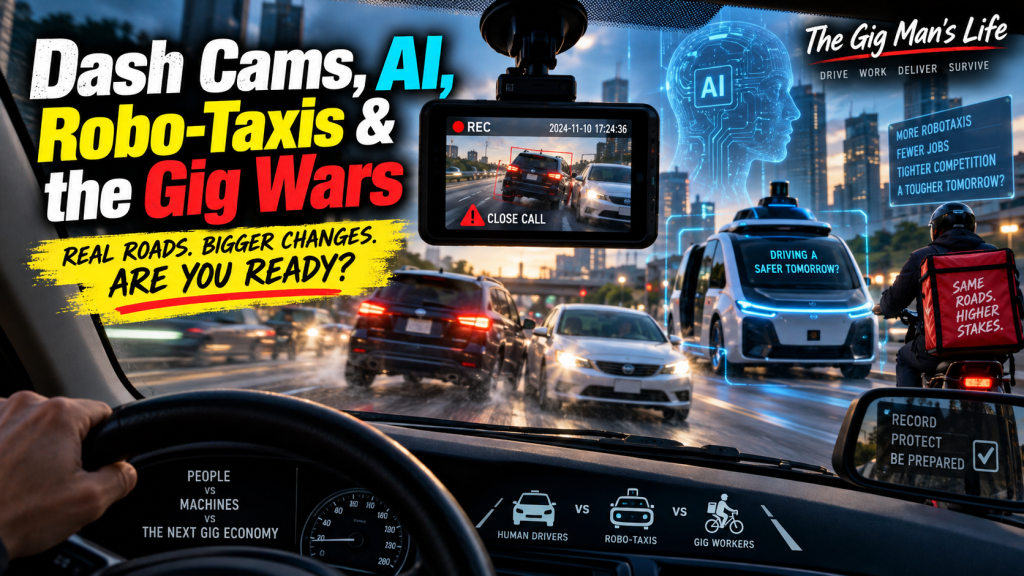
You Cannot Afford to Drive Without a Dash Cam
One subject keeps coming back because I keep seeing examples of why it matters:
Get a dash cam.
And if you’re going to get one, get a good one.
I don’t care whether you’re an Uber driver, delivery driver, commuter, contractor, salesperson, or somebody who drives ten minutes to work every morning. You cannot control what the person in the other vehicle is going to do.
You can control whether you have evidence afterward.
I recently had one of those situations where another driver appeared to decide, essentially, “I’m going that way,” without giving much consideration to the traffic already occupying the road.
That required an immediate decision from me.
And that is precisely the kind of incident where having video matters.
Without the video, somebody investigating an accident might only see where the vehicles ended up. They don’t necessarily see the five seconds beforehand that explain why somebody braked, swerved, crossed a line, or made another emergency maneuver.
The camera does.
And anybody who thinks public roads are Fast & Furious mixed with Grand Theft Auto should probably remember something else:
You’re increasingly surrounded by cameras.
Dash cams. Business security systems. Fleet cameras. Traffic cameras. Doorbell cameras. Cameras built into newer vehicles.
Your bad decision may have an audience you never knew existed.
Now Put a Computer Behind the Wheel
That incident also brings me directly back to autonomous vehicles.
Everybody wants to demonstrate how well a robo-taxi handles normal driving.
Fine.
I’m interested in what happens when there isn’t a good choice.
Suppose a vehicle suddenly enters your path.
Going left risks oncoming traffic.
Going right risks a pedestrian, pole, curb, another vehicle, or something the sensors haven’t completely identified.
Straight ahead means collision.
Braking may not stop the vehicle in time.
A human being can suddenly find themselves deciding between several terrible options.
What does the autonomous vehicle choose?
More importantly, what was it programmed to prioritize when every possible outcome carries risk?
And afterward, who gets the evidence?
If my dash cam records what happened, I possess that recording.
What happens with a robotaxi?
How quickly can police obtain the sensor recordings?
Can an injured person obtain them?
Can an insurance company?
How long does the company retain them?
Can investigators see what the vehicle detected and what decisions its software made immediately before the collision?
Those aren’t science-fiction questions anymore.
They’re transportation-policy questions.
Autonomous Driving Should Be the Co-Pilot, Not the Pilot
This remains one of the areas where I believe driver organizations should be concentrating considerable attention.
Automation can be useful.
Use it to reduce fatigue. Use it for collision avoidance. Use it to warn somebody about something they missed. Use it to make a competent operator safer.
In other words:
Make the computer the co-pilot.
I have a much bigger problem with removing the trained human operator entirely and putting a vehicle onto public streets with passengers inside.
Especially when we haven’t completely answered the questions about emergency judgment, passenger behavior, law enforcement interaction, liability, medical emergencies, children, vandalism, accidents, and access to evidence afterward.
The technology discussion cannot simply be:
“Look! The car drove around the block by itself!”
That’s the easy part.
Show me what it does when everything goes wrong.
The Gig Wars Are Getting Bigger
Meanwhile, the traditional gig economy itself is changing.
We’re no longer simply talking about:
Uber versus Lyft.
Or DoorDash versus Uber Eats.
Companies with enormous existing ecosystems are looking at transportation and delivery.
Walmart has Spark.
Amazon owns enormous logistics infrastructure and has Zoox.
Uber wants autonomous vehicles operating through its marketplace.
Restaurant brands are looking for additional delivery channels.
Retailers want control over their customers from the original order all the way through the last mile.
That’s why I’ve started referring to what we’re seeing as the gig wars.
The companies fighting over gig workers today may eventually be fighting over who owns the customer, who owns the delivery infrastructure, who owns the autonomous fleet, and who controls the software connecting all of it.
And somewhere in that transition is the human driver wondering:
Where exactly do I fit into your five-year plan?
That’s a question drivers should be asking now rather than after somebody else has answered it for us.
AI Isn’t Inventing All These New Jobs
Then we wandered into another favorite internet subject:
“Five AI jobs that can replace your full-time job!”
Okay.
Let’s look at them.
Ghostwriting?
Ghostwriting existed before Claude.
It existed before ChatGPT.
It existed before anybody thought a large language model was something normal people would have running on their phones.
AI didn’t invent ghostwriting.
AI became another tool a writer can use.
That’s an important distinction.
I use ChatGPT constantly in producing The Gig Man’s Life. You’re seeing part of that process during the livestream itself.
I talk.
The conversation gets transcribed.
I throw an enormous amount of context at the AI.
Then I use it to organize what I’m talking about, research ideas, develop articles, clean up arguments, and turn a rambling live discussion into something like the article you’re reading right now.
That’s not hiding AI.
That’s showing you exactly how the sausage is made.
The ideas still have to come from somewhere.
AI can help me organize fifteen minutes of me wandering between dash cams, Uber, Walmart, robo-taxis, Generation X, Douglas Adams, Rumble, YouTube and whatever other squirrel runs across my brain.
But somebody still has to provide the squirrels.
Apparently that’s my job.
Yes, These Articles Are AI-Assisted
I don’t have a problem saying that.
A lot of the material published on The Gig Man’s Life is developed with AI assistance.
And if you watch Breakfast Talk, sometimes you’re literally watching the source material being created.
You’re hearing my original argument before the cleaned-up version exists.
You can see the audio being captured and transcribed.
You can see how the conversation develops.
Then AI helps turn it into something somebody might actually want to read without needing to experience every detour my brain took getting there.
That’s a tool.
A microphone is a tool.
A word processor is a tool.
A video editor is a tool.
AI is another tool.
What matters is whether somebody actually has something worthwhile to say before they press the button.
Douglas Adams Was Right
We also managed to revisit UMass Amherst and rideshare coordination, because somehow Douglas Adams continues to provide one of the better explanations for modern bureaucracy.
Publishing information somewhere does not automatically mean you’ve effectively communicated it to the people who need it.
If you’re closing roads, changing traffic patterns, moving pickup locations, or creating restrictions affecting thousands of people, putting something on a webpage and declaring the public informed isn’t necessarily enough.
That information needs to reach the platforms, drivers, passengers, police, transportation staff and everyone else expected to operate within the new system.
Otherwise we’ve reached:
“But the plans were available.”
Somewhere.
Probably behind a door marked Beware of the Leopard.
Your Rideshare Driver Is Not Your Getaway Car
Then there is another topic that deserves its own discussion:
Your rideshare driver is not your getaway car.
Drivers operate in some interesting places.
Hotels.
Motels.
Bars.
Casinos.
Apartments.
Businesses.
Places where police activity sometimes occurs.
Drivers need situational awareness.
That does not mean assuming everybody coming out of a particular location is doing something illegal.
It means understanding that when something feels wrong, you’re allowed to use judgment.
And once again:
Cameras matter.
Documentation matters.
Knowing your surroundings matters.
The passenger may be thinking about getting from Point A to Point B.
The driver has to think about everything happening between them.
And Somehow Generation X Is Still Here
Generation X also made an appearance in today’s wandering discussion.
Naturally.
We’re apparently at that stage of life where nobody talked about us for several decades and suddenly everyone remembers we exist because we’ve accumulated jobs, homes, careers and retirement accounts.
Welcome back, Gen X.
We were busy.
This Is The Gig Man’s Life
That’s really what today’s livestream became.
Dash cams.
Bad drivers.
Artificial intelligence.
Robo-taxis.
Gig companies.
Delivery companies.
Driver organizations.
The future of work.
University bureaucracy.
Internet algorithms.
Generation X.
And an unnecessarily long discussion about whether I’m broadcasting or streaming.
Technically, I’m streaming.
Although after today’s water joke, I’m probably going to regret using that word forever.
But this is why I enjoy doing The Gig Man’s Life.
Sometimes there isn’t one giant subject.
Sometimes several things happening around us suddenly connect.
Transportation is changing.
AI is changing how people work.
Gig platforms are changing.
Retailers are entering markets they weren’t traditionally associated with.
Autonomous vehicles are becoming part of the transportation discussion.
And ordinary people are carrying better cameras and better technology than entire television crews had not that many years ago.
All of those things collide eventually.
So we might as well talk about them while we’re watching it happen.
And maybe have some fun along the way.
Have a fun, safe, and profitable day.