
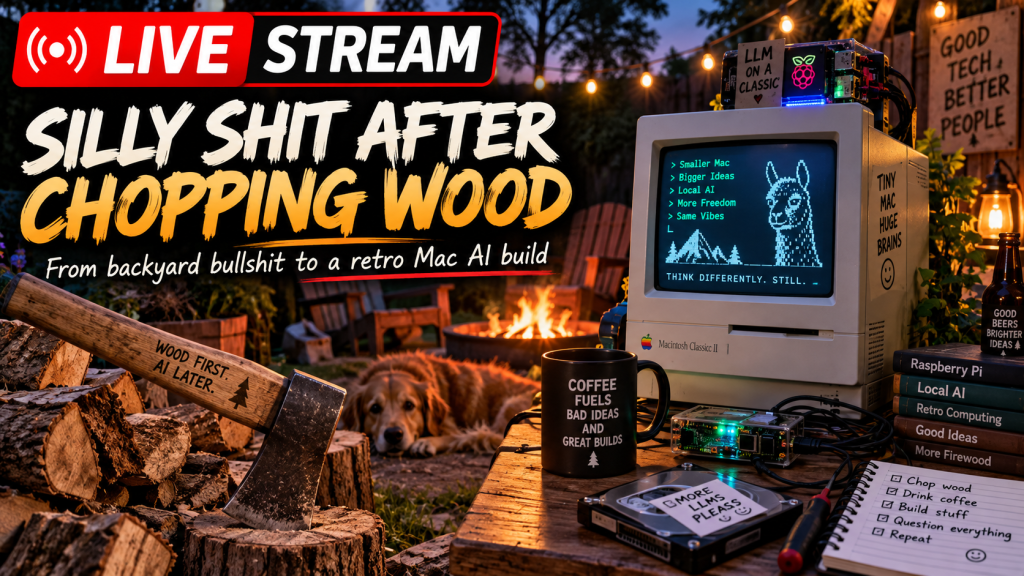
There is a point after chopping wood where your brain probably should be allowed to shut down for the day.
Instead, apparently, mine starts designing computers.
This started as one of those backyard conversations where nobody is trying to solve anything. You’re tired, you’re sitting around talking shit, somebody brings up crabapple trees, somebody else starts talking about making alcohol out of them, and twenty minutes later the conversation has somehow moved into artificial intelligence, robot girlfriends, the apocalypse, solar power, Raspberry Pis, and the question of whether an old Macintosh Classic II could become an artificial-intelligence appliance for a business.
This is what happens when you think about silly shit after chopping wood.
The funny thing is that some of the silly shit eventually stops being silly.
We were talking about how I use speech-to-text with AI. I tend to dictate ideas instead of sitting down and carefully typing everything out. Part of the reason is simple: I can talk through an idea much faster than I can type it.
The first version is not pretty.
It includes corrections.
It includes unfinished sentences.
It includes profanity.
It includes somebody interrupting me.
It includes me interrupting myself.
Sometimes it includes somebody saying something so completely unrelated that the conversation goes straight off a cliff.
The AI’s job is not necessarily to replace any of that. It is to figure out what the hell I was trying to say and turn it into something another human being can follow.
And sometimes it should just leave the shit as the shit.
That discussion somehow led to the idea of digital companions.
Then somebody brought up something that sounded suspiciously like Cherry 2000.
For anybody unfamiliar with that movie, imagine a future where synthetic human companions have become consumer products.
So naturally the conversation became:
How much would one cost today?
Two hundred thousand dollars?
No.
Two hundred thousand dollars is the down payment.
Once you start adding realistic skin, heating, full-body motion, household chores, massage, health monitoring, continuous artificial intelligence, vision, hearing, memory, autonomous navigation and everything else people immediately start demanding from their imaginary robot, you are no longer talking about a fancy appliance.
You are talking about an enormous engineering project.
Then somebody says she has to do laundry.
Then dishes.
Then somebody wants a massage.
Then somebody starts specifying physical characteristics.
And suddenly we have created a twenty-million-dollar machine after spending six billion dollars developing it.
This is how engineering meetings probably really work.
But underneath the jokes was something interesting.
What happens when artificial intelligence stops being something you visit on a website and starts becoming an appliance that sits in the room?
That brought me back to something I am already building.
I have an old Macintosh Classic II case.
The original computer is long past being useful as a modern machine, but the enclosure is still one of the most recognizable computer designs ever made.
Instead of throwing it away, I started rebuilding it.
There is an LCD display in the front.
There is a Raspberry Pi mounted internally.
There is a cooling system.
I am redesigning the power system so that instead of feeding 120-volt AC into the machine like the original Macintosh did, I can use an external Dell-style 19-volt laptop power supply.
That 19 volts can enter the machine as DC and then be converted internally into the voltages everything actually needs.
That removes mains electricity from most of the interior and gives me one centralized power source.
Then the idea got bigger.
Because of course it did.
What if the Raspberry Pi behind the display wasn’t actually the main computer?
What if it was simply the interface?
The screen.
The keyboard and mouse interface.
The microphone.
The speaker.
The cameras.
Fan control.
Temperature monitoring.
System status.
Basically the face of the machine.
Then behind it could be a small Raspberry Pi cluster.
Several Pi 4 boards could be installed where the original Macintosh logic board once lived.
Instead of giving every Pi its own drive, the cluster could network boot.
One central machine could provide storage.
The individual Pi boards could boot across Ethernet and share data from centralized storage.
At that point the custom board inside the Macintosh stops being just a power board.
It becomes a backplane.
Power goes in.
Network goes out.
The nodes slide into place.
The entire machine begins functioning more like a miniature blade server than an old home computer.
And that is when the silly conversation suddenly turned into something useful.
What would you actually do with it?
One idea is automotive technical work.
Load the system with service manuals.
Repair procedures.
Wiring diagrams.
Torque specifications.
Technical service bulletins.
Parts information.
Your own repair notes.
Diagnostic information.
Instead of trying to make a giant language model memorize everything, the system could use retrieval.
Ask it a question:
“I have a cylinder-three misfire on this vehicle. What should I check before replacing the injector?”
The AI searches the manuals.
It finds the relevant diagnostic procedure.
It pulls the wiring diagram.
It finds the specifications.
Then it explains what it found.
More importantly, it tells you where it found it.
That last part matters.
When somebody is working on a vehicle, I do not want an AI confidently inventing a torque specification.
I want:
“Here is the specification. Here is the manual. Here is the page.”
Now the old Macintosh becomes a conversational shop manual.
But why stop with automotive work?
Put one in a machine shop.
Give it the manuals for the equipment.
Give it maintenance schedules.
Give it operating procedures.
Let it monitor machine status.
Put one in a small business.
Give it policies.
Inventory information.
Documentation.
Maintenance records.
Schedules.
Technical procedures.
Now the same little beige box becomes an operations terminal.
The hardware barely changes.
The knowledge changes.
Then I started thinking about cameras.
Older USB cameras are cheap.
USB 2.0 is more than adequate for a lot of low-speed machine-vision tasks.
A small powered USB hub could live inside the machine.
Strip the plastic housing off.
Mount the board internally.
Feed it from the regulated five-volt rail.
Now the Macintosh could have multiple internal cameras.
Three cameras gets interesting.
Put them at known positions.
Calibrate them.
Take images from three different angles.
Now software has geometry.
You can start estimating depth.
Position.
Size.
Movement.
Object orientation.
You do not necessarily need continuous video either.
Pulse the cameras.
Capture three images.
Process them as one observation.
Now the AI has eyes.
Put a part in front of the computer.
“What is this?”
The cameras inspect it.
Computer vision identifies visible features.
The document system searches the manuals.
The language model explains what the part likely is and where it belongs.
That is where the old Macintosh stops being a Raspberry Pi project and starts becoming a general-purpose technical appliance.
There is another reason I like doing this with an old Macintosh.
Modern artificial-intelligence hardware tends to look exactly like modern artificial-intelligence hardware.
Black box.
Rack server.
Plastic appliance.
Tablet.
Generic screen.
This thing would look like a cute little Macintosh from the early 1990s.
Most people would never expect what is inside.
That also makes it approachable.
Instead of somebody walking into a shop and seeing an intimidating wall of servers, they see a little beige computer sitting on a counter.
Except that little beige computer could be monitoring equipment, searching thousands of pages of technical documentation, running machine vision, controlling its own cooling system, and answering questions through a local language model.
It might even be able to run without the Internet.
That matters too.
The more we talked, the more the conversation started circling around ownership.
Local power.
Solar.
Battery storage.
Local computing.
Local documentation.
Local artificial intelligence.
Technology that continues working even if somebody else’s cloud service disappears.
Technology that you can repair.
Technology that you actually understand.
I am not pretending that a Raspberry Pi cluster is suddenly going to become some giant datacenter AI system.
It won’t.
But not every AI system needs to know everything in the universe.
Sometimes it needs to know everything about one shop.
One business.
One machine.
One vehicle.
One set of manuals.
That is a much more achievable problem.
And there is something appropriately ridiculous about building it inside a Macintosh Classic II.
We started the afternoon talking about crabapples.
Then hard cider.
Then artificial intelligence.
Then synthetic people.
Then robot maintenance contracts.
Then the apocalypse.
Then solar panels.
Then energy efficiency.
Then Raspberry Pi clusters.
Then machine vision.
Then technical documentation.
And eventually we accidentally designed a fairly interesting little AI workstation.
That is apparently what happens when you chop wood and then sit around talking shit with your friends.
You should probably rest afterward.
Apparently I design computers instead.