
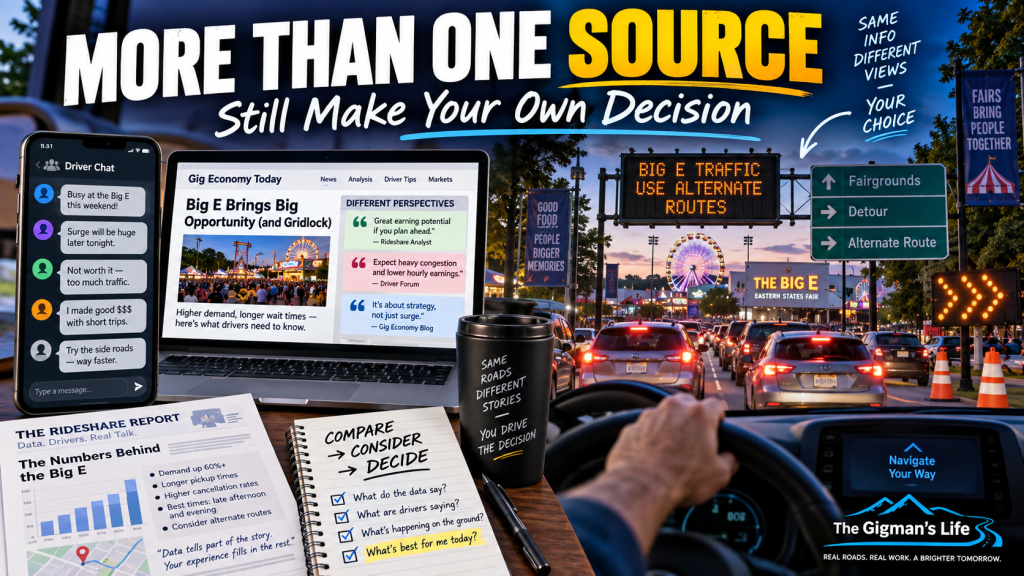
One of the things I keep coming back to when I talk about Uber, technology, the gig economy, or really anything else on The Gigman’s Life is that I don’t think you should get all your information from one person.
Including me.
If something interests me enough to talk about it, I usually want to hear what several people have to say about it. I want to see the original announcement when possible. I want to hear somebody who thinks it is a good idea. I want to hear somebody who sees potential problems with it. Then I want to take all of that information, mix in my own experience, and decide what I think.
That was exactly what happened while I was looking at Uber’s latest “Only on Uber 2026” announcement.
I listened to The Ride Share Guy break down the individual changes Uber is introducing. He focused largely on what those changes could mean operationally for drivers: cancellation-rate protections, destination changes, additional compensation when trips take longer than expected, earlier wait-time pay at stops, new ways of tracking quests and earnings, and Uber bringing artificial intelligence and voice controls further into the driver app.
Then I listened to Ride Share Pro discuss the same announcement.
He was looking at it from a different angle.
Instead of just asking what these new features do, he was asking what they might tell us about the direction Uber is going as a company. He focused more heavily on autonomous vehicles, Uber expanding into other types of work, deliveries, shopping, returns, and the possibility that human drivers may increasingly find themselves doing work other than simply moving passengers from Point A to Point B.
Those are two different ways of looking at exactly the same announcement.
Then there is Uber itself.
Uber obviously has its own perspective. It is introducing products and explaining why it believes those products are improvements.
All of those sources are useful.
None of them should automatically become your opinion.
That became especially obvious to me when Uber started talking about putting a voice assistant into the driver app.
At first glance, that sounds like a very good idea.
Anything that reduces how much a driver has to physically interact with a phone while driving deserves consideration.
But then the technical side of my brain starts thinking about what happens when there are other people in the vehicle.
Speech recognition has become incredibly good.
I remember Dragon NaturallySpeaking back in the 1990s. My mother remembers it too, because we spent a decent amount of money on software that, at the time, seemed almost magical when it actually recognized what somebody was saying.
Today, that technology is basically everywhere.
Apple can transcribe speech.
ChatGPT can transcribe speech.
Phones can understand conversations involving several people remarkably well.
But recognizing speech and recognizing the speaker are two completely different problems.
A computer can understand the words “cancel the trip.”
That does not necessarily mean it knows whether those words were spoken by the driver or by the passenger sitting behind the driver.
That becomes important if voice commands eventually start doing anything consequential.
Maybe asking, “How much have I earned today?” does not require much authentication.
But what about sending a message?
Changing something about a trip?
Changing a destination?
Canceling?
Changing account settings?
At some point you have to ask whether a voice command is really safer than simply having a large, obvious button located somewhere on the screen where the driver can use it when appropriate.
Sometimes the simplest interface really is still a button.
That is something I thought about after hearing Uber explain the feature and then hearing other people discuss what the announcement means.
Nobody necessarily has to be wrong.
They are simply looking at different parts of the problem.
And while I was thinking about all of this, I got a wonderfully appropriate real-world demonstration of the exact same principle.
I was taking my mother to an appointment around the area where I grew up.
This wasn’t a navigation problem.
I don’t need GPS to tell me how to drive around my hometown.
I already know these roads.
The problem was that I had mentally programmed myself to go one direction.
Then I started second-guessing myself.
I turned around to get onto what I thought was the better route.
Then I realized I probably should have done exactly what I originally planned and gone all the way around.
By that point, though, I had already committed myself to the correction.
And then I got sucked directly into Big E traffic.
For people outside western Massachusetts, the Big E—officially the Eastern States Exposition—can produce some truly impressive traffic around West Springfield.
Suddenly I couldn’t get off where I wanted to get off.
Then I couldn’t get off somewhere else.
Then I was going around another way trying to get where I was going.
Somewhere in the middle of all this, somebody was listening to the Beastie Boys, which somehow felt like an appropriate soundtrack for driving around in circles trying to find another way through traffic.
And I eventually got my mother to her appointment.
But I would have gotten there sooner if I had trusted my first instinct.
That is actually an important part of this discussion about getting information from multiple sources.
Getting more information does not mean automatically abandoning what you already know.
Sometimes new information improves your decision.
Sometimes another person sees something you missed.
Sometimes somebody has expertise that you don’t have.
And sometimes you start second-guessing yourself so much that you abandon the perfectly reasonable decision you made in the first place.
The purpose of getting several sources is not to find somebody who will tell you what to think.
It is to give yourself more information before you decide what you think.
That distinction matters.
It especially matters in the gig economy.
Someone driving Uber in Los Angeles may have a completely different experience than somebody driving in Springfield, Massachusetts.
An Uber promotion that makes perfect sense for one driver might make absolutely no sense for another.
An acceptance-rate challenge might offer you $75.
Great.
But if earning that $75 requires you to accept $100 worth of trips that you normally would have rejected, was it really a $75 bonus?
Maybe Uber introduces another delivery opportunity.
That might be great if the delivery is five miles across town.
It becomes an entirely different kind of job if Uber wants you to pick up an item and drive it halfway across Massachusetts.
The information Uber gives you matters.
The opinions of other drivers matter.
The analysis from people who cover the industry matters.
Your own experience matters too.
And none of those things should completely replace the others.
That is why, when possible, I like going back to the original source.
If I am talking about an Uber announcement, I want people to be able to watch Uber’s announcement.
If The Ride Share Guy has a breakdown of it, watch that too.
If Ride Share Pro has another interpretation, listen to him.
Then listen to me sit here and bullshit about whatever part of it caught my attention.
And after all that?
Make your own decision.
You might agree with me.
You might think I completely missed something.
That is fine.
I would rather somebody disagree with me after looking at the information than agree with me simply because I was the only person they listened to.
And that brings me back to what The Gigman’s Life really is.
Driving Uber is a gig.
Making these videos is also a gig.
Running the website is a gig.
Researching something, listening to other creators, reading announcements, maintaining equipment, paying for internet, hosting, cameras, microphones, computers, and everything else involved in producing this stuff takes time and money.
Nobody is paying me to tell you that Uber is wonderful.
Nobody is paying me to tell you Uber is terrible.
Nobody is paying me to tell you whether a voice assistant is a brilliant idea or a terrible one.
If something interests me, I look at it and think:
You know what?
That’s interesting.
Let me bullshit about that for a while.
So The Gigman’s Life continues to be presented by and sponsored by the same organization that has sponsored it from the beginning:
Me.
And maybe that is the best way to describe the whole philosophy behind this site.
Get the information.
Get another source.
Listen to another opinion.
Use your own experience.
And then make your own damn decision.
Preferably before you turn toward the Big E and realize you really should have gone the other way.