
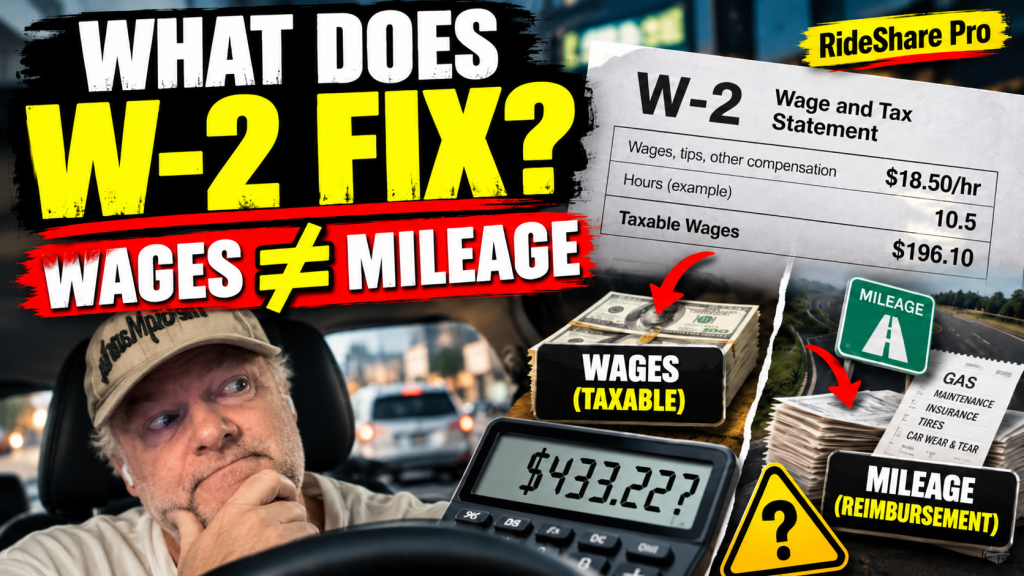
I watched RideShare Pro’s video making the argument that rideshare drivers should not be afraid of becoming W-2 employees, and the farther I got into it, the more one question kept coming back to me:
What exactly do you think the W-2 is going to fix?
Because there are real problems in rideshare.
There are problems with compensation. There are problems with mileage. There are problems with waiting time. There are problems with upfront pricing, deactivation, training, transparency, vehicle expenses, and how much control Uber and Lyft can exercise while still calling us independent contractors.
I agree that there is a lot wrong with this industry.
What I do not agree with is taking all of those problems, dropping them into one bucket, writing W-2 on the side, and acting like that somehow solves them.
That is where RideShare Pro loses me.
He starts with hypothetical numbers.
Take a driver working about 10.6 hours. Use an hourly wage of $18.50. That comes out to $196.10. Then take 312 miles, multiply that by the federal mileage rate, and suddenly we have a number over $400.
It sounds great.
Until you start separating the numbers.
The driver did not earn more than $400 in wages.
The driver earned $196.10 in wages.
The rest was supposedly reimbursement for using the driver’s own vehicle.
Those are not the same thing.
I treat my vehicle almost like another employee in the business. The vehicle has to get paid too.
Every mile means fuel, tires, oil, brakes, maintenance, insurance, depreciation, repairs, and eventually replacing the vehicle altogether.
If I receive money because I drove 300 miles, that is not just bonus money sitting there waiting for me to spend.
Part of that money belongs to the car.
And then we get into the much bigger problem with the calculation.
What are those 312 miles?
Were all 312 miles driven with passengers?
Were some of them pickup miles?
Were some repositioning?
Were some spent driving from one market to another?
Were some personal miles?
Were all 312 supposedly reimbursable?
Later in the video he even acknowledges that he does not necessarily think every mile would be reimbursed.
Okay.
Then why did we use all of the miles to build the impressive number in the first place?
That is where I start asking questions.
If you are going to show me the benefit of W-2 employment, then show me exactly which miles Uber would reimburse under this imaginary system.
Because otherwise we are multiplying assumptions by assumptions.
The same thing happens when he talks about getting paid for every hour you are online and available to work.
That is an employee way of looking at work.
If my employer tells me I have to be somewhere from 8:00 to 4:00, then yes, I expect to get paid from 8:00 to 4:00.
But self-employment does not work like that.
There are hours when you are not going to get paid.
There are hours spent waiting for business. There are hours maintaining equipment. There are hours cleaning. There are hours repositioning. There are hours doing paperwork. There are hours researching where the work is.
Sometimes you work on something for three hours and make nothing.
That is part of owning the business risk.
I have done flat-rate work before. I have done work where the job paid X amount whether it took me three hours or six.
That is self-employment.
The customer is buying the result.
They are not necessarily buying every minute of my time.
The minute Uber has to pay me simply because I am available, Uber is no longer only purchasing transportation from me.
Uber is purchasing my time.
And when somebody purchases your time, they get a lot more interested in controlling when they purchase it.
That is where the scheduling issue comes in.
RideShare Pro talks about his wife being a nurse and being able to write her own schedule.
But that is not the same thing.
A nurse may be able to select shifts.
The hospital still decides which shifts need to exist.
There are only so many positions that need to be filled.
That is completely different from me deciding at 11:17 in the morning that I feel like working and turning Uber on.
If Uber has to pay every driver who turns the app on, Uber is not going to allow an unlimited number of employees to clock in whenever they feel like it.
They are going to manage labor.
Maybe it is called block scheduling.
Maybe it is called open shifts.
Maybe it is called self-scheduling.
Whatever name they put on it, somebody eventually sees:
No shifts available.
RideShare Pro eventually gets into block scheduling himself, which is where I find the earlier nurse comparison even more confusing.
Once you are selecting from employer-created blocks, you no longer have the same kind of freedom you have today.
You have flexibility within the company’s schedule.
That is different from creating your own schedule.
Then we get the police officer comparison.
The argument becomes something along the lines of, “Well, we do not stop paying police officers just because there is nobody arrested in the back of the cruiser.”
Okay.
Of course we do not.
A police officer is already an employee working a scheduled duty period.
The department is paying for that officer’s entire period of availability.
It is also controlling when that officer works, where that officer works, and what that officer does during the shift.
You cannot take the good part of that employment relationship — getting paid while waiting — and ignore the other side of it.
If Uber is going to pay me for an entire block of availability, then Uber is also going to start asking where I am, what I am doing, why I am not accepting something, and whether they actually need me working at all.
That is the trade.
Then we move on to McDonald’s and 401(k)s and all the other things that employees supposedly get.
And this is another place where the presentation starts bothering me.
A W-2 does not automatically mean:
$18.50 an hour.
Mileage reimbursement for every mile.
401(k).
Employer match.
Health insurance.
Unlimited hours.
Unlimited scheduling freedom.
Paid availability.
Those are all separate things.
An employer may offer some of those things.
An employee may qualify for some of those things.
But simply becoming a W-2 employee does not magically place all of them into your compensation package.
And even with something like a 401(k), I have worked for companies that offered them.
The employer chooses the plan.
The employer chooses the financial provider.
You choose from the investments inside that plan.
Personally, if I am properly compensated, I would rather decide what I want to do with my money.
If I want to invest it, I can invest it.
If I want to put it into vehicle replacement, I can do that.
If I want to put it into an IRA or brokerage account, that is my choice.
Pay me correctly first.
Do not give me an imaginary benefit package and tell me that solves the underlying problem.
Because that is what I think this whole W-2 discussion keeps missing.
The major problem is not necessarily classification.
The major problem is compensation.
Are we properly compensated for our time?
Are we properly compensated for the vehicle?
Are we properly compensated for pickup mileage?
Are we properly compensated for waiting?
Is the pricing transparent?
Are we properly compensated for mandatory training?
Are we protected from arbitrary deactivation?
Those are individual problems that can be addressed individually.
Massachusetts is already an example of that.
We have an engaged-time earnings floor.
We have sick time.
We have additional protections.
Could those protections be better?
Absolutely.
I still question why sick time is valued the way it is and why the cap works the way it does.
But that is a sick-time policy problem.
I do not need somebody to hand me a W-2 before we can have that conversation.
The same thing applies to training.
I think rideshare needs real training.
Paid training.
Actual training on policies, passenger issues, safety, appeals, and deactivation procedures.
That does not automatically require turning every driver into an employee.
And the same thing applies to mileage.
If drivers are not being compensated fairly for mileage, then fix mileage.
Give us a transparent mileage rate.
Give us a time rate.
Give us a waiting rate.
Give us a pickup rate.
Stop hiding everything behind an algorithm and saying, “Here is the offer.”
That is a compensation problem.
Not necessarily an employment problem.
And this is where I think RideShare Pro is mixing two completely different arguments together.
One argument is:
Drivers should be properly compensated for the labor and equipment they provide.
The other argument is:
Drivers should become W-2 employees.
Those are not the same argument.
You can support the first one without supporting the second one.
That is where my perspective differs.
I have worked hourly jobs.
I have worked contract jobs.
I have worked jobs where I was paid a flat amount to complete the work.
I have worked in corporate security.
I have worked in IT security.
I have sold things.
I have done work where I was responsible for whether the job was profitable or not.
So when somebody tells me that becoming W-2 is going to fix everything, my first reaction is not excitement.
My first reaction is:
What changes after that?
What does Uber do the next morning?
How many drivers are allowed to clock in?
Who gets the good blocks?
Who gets the bad blocks?
What happens when demand drops?
Can Uber shut you off because they have too many drivers?
Can you still drive where you want?
Can you still stop when you want?
Can you work Uber and Lyft whenever you want?
Which mileage counts?
What happens to the Massachusetts pay structure?
What happens to the flexibility that caused many people to enter gig work in the first place?
Those are the questions I want answered.
Because I do not think drivers should be afraid of a W-2.
I think drivers should be skeptical of anybody telling them what a W-2 supposedly gives them without defining the actual job that comes with it.
That is my issue with RideShare Pro’s video.
He keeps talking about nurses, police officers, McDonald’s workers, mileage reimbursement, retirement plans, and hypothetical hourly wages.
But none of those comparisons answers the main question:
What problem in rideshare specifically requires us to become employees in order to fix it?
If the problem is pay, fix the pay.
If the problem is mileage, fix the mileage.
If the problem is waiting time, fix waiting time.
If the problem is training, train us.
If the problem is deactivation, create due process.
If the problem is platform control, regulate platform control.
But do not tell me that changing a tax form automatically solves all of those things.
Because it does not.
And if we are not careful, we could end up with the same compensation problems we have today — except now we also have to ask permission before we clock in.