
When people talk about using artificial intelligence, the conversation frequently gets reduced to a few simple examples. Write an email. Summarize a document. Generate an image. Answer a question. Maybe write a little code.
That isn’t remotely where I have ended up.
Over time, I have started looking at what I actually ask AI to do for me, and the list has become somewhat ridiculous. More importantly, it has made me reconsider the usual question of whether an AI subscription is worth the money. The better comparison for me isn’t another piece of software. It is the collection of people I would otherwise have to hire, call, consult, or bother every time one of my projects wandered into another discipline.
Take the Macintosh Classic conversion I’ve been building.
What began as putting modern hardware into an old Macintosh case turned into mechanical engineering, thermal management, electronics, PCB design, embedded programming, Linux administration, networking, power management, 3D printing and eventually industrial-design questions.
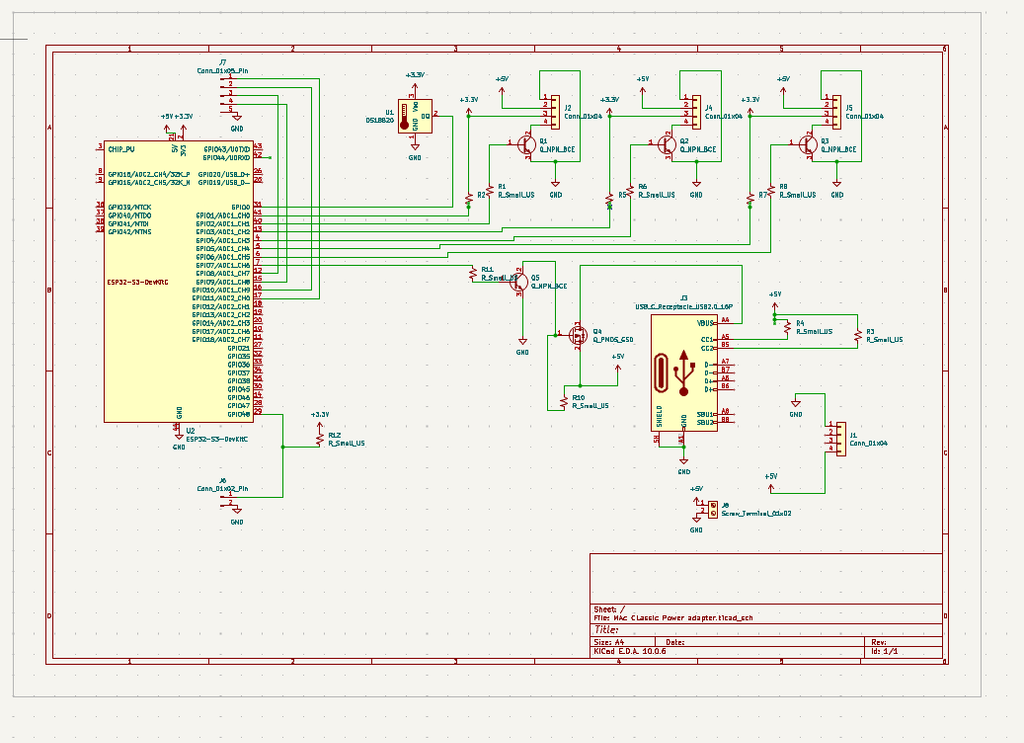
During just the electronics portion, I have been sitting in KiCad building a custom controller board. AI has been walking through the schematic with me while I learn it.
The board now has an ESP32-S3 acting as the always-on controller. It has three independent four-wire fan channels with PWM control and tachometer feedback. There is a temperature sensor, a soft-power button input, a high-current MOSFET switching circuit for the Raspberry Pi, regulated 5-volt distribution, USB-C power output and a serial/control connection between the ESP32 and Raspberry Pi.
The ESP32 can eventually know whether the Pi is running, tell it to shut down, receive temperature information from Linux, manage fan curves and control when the Pi actually receives power.
That means one conversation crossed several jobs that would traditionally belong to different people.
An electronics technician could help me understand the transistor circuits. An electrical engineer could review the power architecture. Someone familiar with PCB design could walk me through KiCad. An embedded developer could write the ESP32 firmware. A Linux person could handle the Raspberry Pi communication. Someone else might design the mechanical mounts. And somebody still has to document the whole thing.
I have used AI in all of those roles.
It isn’t just the electronics
The mechanical side of the same project has involved designing brackets, dovetail rails, modular cages and airflow systems for 3D printing.
We have discussed whether printed PLA structures could carry meaningful loads, why dovetail joints improve the design, how to orient a Raspberry Pi vertically, how to create a chimney effect through an old Macintosh enclosure and where fans should be placed.
Then I actually tested it.
The Pi that was idling in the mid-20-degree Celsius range only climbed into roughly the 30s and around 40°C under artificial load, far below its thermal-throttling range. That turned the conversation from speculative design into analyzing real test results.
AI then became the technical writer that helped turn those results into an article.
That progression happens repeatedly.
I have an idea.
AI helps me think through it.
I build something.
I bring the results back.
We troubleshoot it.
Then AI helps me document what happened.
That is very different from asking a chatbot a question.
Then there is the IT department
I also run my own infrastructure.
That means Proxmox, Unraid, Raspberry Pis, Docker containers, DNS, Tailscale, local AI models, Open-WebUI, Ollama, Linux servers and assorted services that I have decided would apparently be entertaining to run myself.
AI ends up being the person standing over my shoulder when something produces an error message at midnight.
It helps read logs, work through configuration files, explain why a service failed, construct commands, evaluate network designs and figure out whether the problem is software, permissions, DNS, Docker networking, hardware or me having done something stupid six steps earlier.
Traditionally, that might be a systems administrator, network administrator or support engineer.
Instead, I can have that conversation immediately.
Then I decided to run AI locally
That created another job.
Now AI is helping me evaluate AI.
I’ve used it to work with Ollama, Open-WebUI and different local models, think about hardware requirements, compare architectures and explore what a privately hosted AI system could realistically do inside a home or business.
That conversation can suddenly wander into GPU memory, unified memory, Kubernetes, model quantization, privacy requirements, PCI compliance and whether businesses may eventually prefer local inference for sensitive information.
At that point I am effectively using AI as a research analyst and technical consultant.
Then there is programming
I am not just asking it to explain code.
I’ve had AI help design applications, APIs, Node and Python utilities, web interfaces, automation systems, monitoring tools and integrations.
Sometimes it writes the initial code.
Sometimes I break it.
Sometimes the code breaks itself.
Then we spend the next hour figuring out which one of us caused the problem.
That is much closer to working with a developer than searching Stack Overflow.
And the particularly useful part is continuity. I can discuss why something was designed a certain way, change the requirements and then have the design reevaluated instead of beginning from scratch.
Then there is my website and shows
AI also functions as part of the production staff for The Gigman’s Life.
I can finish a livestream and turn around and say that I need the description.
I can spend an hour verbally developing an idea and then ask for the article.
I can take a technical experiment, a rideshare experience, a piece of technology news or some ridiculous project I built and turn the conversation into something publishable.
That traditionally involves some combination of a producer, editor, copywriter, researcher and technical writer.
There is also continuity between those jobs. The person helping me understand the technical subject is the same system helping me explain it to an audience afterward.
That matters.
Technical writers traditionally have to interview technical people because knowing how something works and explaining how it works are separate jobs.
With AI, much of the interview has already happened during the development process.
Research has become its own category
I’ve used AI to research technology, transportation, gig-work policies, court cases, company announcements, hardware specifications and historical claims.
Sometimes it is something substantial.
Sometimes somebody on YouTube says something that makes me go, “That doesn’t sound right.”
Instead of spending the next two hours opening twenty browser tabs, I can ask AI to start pulling the thread apart.
That doesn’t eliminate the need to check sources. In fact, AI is most useful when it exposes the sources and lets me decide whether the conclusion makes sense.
But it dramatically changes the time involved.
That is work a researcher or research assistant would normally perform.
It has also become part of the creative process
Then things get stranger.
I have used the same AI system to develop fictional universes.
There is Five Days With G, with characters, businesses, financial histories, relationships and multi-season story arcs that have to remain internally consistent.
There is the Burn Notice continuation concept, with existing canon mixed with new characters, family histories and episode structures.
At that point AI becomes a writers’ room assistant and continuity editor.
It can ask whether a character’s behavior fits what we established six chapters ago or remind me that something I’m considering contradicts the timeline.
That is another real job.
And apparently it is also an engineering notebook
This may actually be one of the more important roles.
For years, people who build things have kept notebooks.
You write down what you tried, what failed, measurements, ideas and what you’re going to try next.
My AI conversations increasingly serve that function.
The difference is that the notebook talks back.
If I say the Pi reached 37°C during a test, the notebook can compare that with what we were trying to accomplish.
If I later change the fan arrangement, it knows why the original arrangement existed.
If I replace an Arduino with an ESP32, it can reconsider the rest of the system based on capabilities I didn’t have before.
That makes it less like documentation and more like a persistent engineering partner.
What would I have to pay people to do all of this?
This is where the comparison starts getting interesting.
Forget trying to assign some magical dollar value to an AI response. Instead, look at the human jobs represented by the work.
I would potentially need access to an electronics or PCB consultant, embedded programmer, Linux administrator, network administrator, software developer, technical researcher, technical writer, editor, content producer, mechanical-design consultant and creative-development assistant.
Obviously I wouldn’t employ eleven people full time.
That isn’t the comparison.
The realistic comparison is that I would need to buy pieces of their time whenever I needed them.
An hour here.
Two hours there.
A consultation about the power circuit.
Someone to review the PCB.
Someone to fix the Docker installation.
Someone to write the article.
Someone to research the law.
Someone to debug the program.
Someone to help structure the story.
And there is another cost that gets ignored: finding the person.
I would have to identify somebody with the appropriate skill, explain the project, bring them up to speed, wait until they were available and then pay for enough time that the engagement was worthwhile.
For some of the tiny questions I ask AI, hiring a human would be absurd.
Nobody hires an electrical engineer for seven minutes because they cannot remember which side of a transistor should connect to the PWM line.
But those seven-minute problems accumulate.
They are precisely the little obstacles that can stop a hobby project for two days.
AI removes a lot of those interruptions.
That doesn’t mean AI replaces every one of those people
There is an important distinction.
If I were designing a commercial high-current power product, I would still want an experienced electrical engineer reviewing it.
If I were making a serious legal decision, I would want an attorney.
If code were going into a critical production environment, it should receive proper engineering review.
AI can also simply be wrong. I’ve caught it doing so, and sometimes the next ten minutes of the conversation consists of figuring out what it screwed up.
But that is not really the point.
The point is that there is an enormous territory between knowing nothing and needing a professional to assume responsibility for the final result.
That middle territory is where AI has become extraordinarily useful.
It helps me get from an idea to something developed enough that I know what questions actually need professional attention.
That changes the economics of tinkering
There are projects I probably would not have attempted before.
Not because they were impossible.
Because the friction was too high.
I might know that I could figure something out eventually, but learning an unfamiliar piece of software, researching a circuit, finding a connector, understanding the documentation and troubleshooting everything afterward could turn a weekend experiment into a month-long distraction.
Now I can sit down and effectively say:
Here’s what I’m trying to do.
What am I missing?
And then keep going.
That lowers the cost of curiosity.
For somebody who constantly wanders between computers, electronics, fabrication, writing, transportation, video production and whatever ridiculous idea showed up that morning, lowering that cost is significant.
So what exactly am I paying for?
That is why I have started reevaluating what an AI subscription represents.
I don’t think of it as paying for a chatbot anymore.
I’m paying for immediate access to something that can occupy a surprising number of assistant-level roles depending on what I happen to be doing that hour.
It isn’t an electrical engineer.
It isn’t a programmer.
It isn’t an editor.
It isn’t a researcher.
It isn’t a producer.
But it can perform useful portions of all of those jobs well enough that I would otherwise have to spend considerable time—or considerable money—getting the same amount of assistance.
And perhaps the biggest difference is that I don’t have to schedule a meeting with it.
At three in the afternoon, I can be designing a MOSFET power switch.
At four, I can be writing an article about why I designed it.
At five, I can be troubleshooting Linux.
Later that night I might be developing a television story that doesn’t exist.
The same assistant follows me through all of it.
That may ultimately be the more interesting way to measure the value of AI.
Not by asking how much one answer is worth.
Ask instead:
How many different people would I have needed to call to accomplish everything I asked it to help me with this week?
In my case, that answer has become a surprisingly long list.