
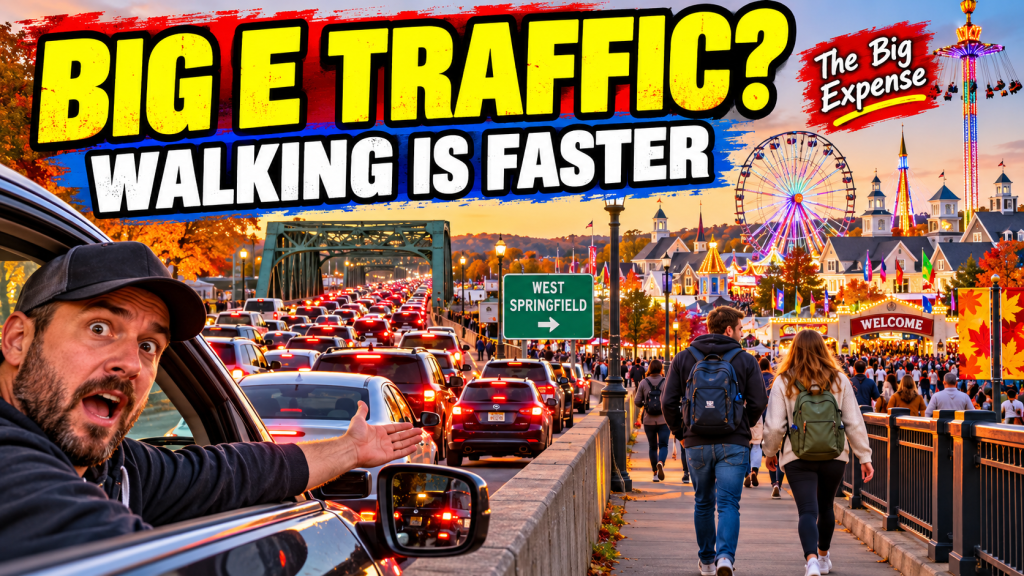
If you live around Western Massachusetts, you don’t need me to explain what the Eastern States Exposition is.
It’s The Big E.
It’s the big New England fair in West Springfield where all six New England states get together, everybody eats things they probably shouldn’t, and you can somehow spend an impressive amount of money without entirely understanding where it all went.
Around here, I sometimes think we should call it The Big Expense.
And on the final weekend of the Big E, particularly when the weather is nice, there is something else you can count on:
Traffic.
Lots and lots of traffic.
That’s one reason I generally try to keep myself farther north around Amherst when I’m driving rideshare during the busiest parts of the fair.
I know what happens around West Springfield.
The problem is that avoiding the Big E doesn’t necessarily mean the Big E avoids me.
Eventually somebody gets into the car and says:
“I’m going to the Big E.”
Okay.
Here we go.
When Walking Becomes Faster Than Driving
This is one of those situations where knowing the area actually matters.
A passenger sees the navigation system.
I see the navigation system too, but I also know what happens once we get into certain traffic patterns around West Springfield.
You can start with an estimated arrival of 20 minutes.
Then it drops to 15.
Then 11.
Everything looks wonderful.
Then suddenly it says 17.
Then 20.
That’s when I start paying attention.
Because there are points around the Big E where you’re no longer just driving toward traffic.
You’re about to become part of it.
The Memorial Bridge area is one of the big dividing lines for me. Once you get committed to certain approaches toward Memorial Avenue and the fairgrounds, your opportunities to say, “Forget this, I’ll just go around,” start disappearing.
Once you’re trapped in that line, you’re trapped in that line.
And this is where I occasionally have to explain something to a passenger that sounds strange coming from a rideshare driver:
You may want to stop paying me and start walking.
Seriously.
If I can get you within a mile or maybe a mile and a half of the Big E, find a legitimate and safe place to discharge you, and put you somewhere with a proper sidewalk route to the fairgrounds, we may have reached the point where your feet are going to beat my car.
I’m not throwing you out.
I’m not refusing to finish your trip.
And I’m certainly not trying to milk another twenty minutes of fare out of you while we stare at somebody else’s brake lights.
I’m telling you what I’m seeing.
If you’re looking at roughly a twenty-minute walk and my navigation system is also telling us twenty minutes by car—with the driving estimate getting worse instead of better—you have a decision to make.
You can sit comfortably in my car.
That’s fine.
But you’re going to keep paying for that privilege while we’re barely moving.
Or you can take a twenty-minute walk and probably arrive at about the same time.
Possibly earlier.
That actually happened to me.
I explained the situation to the passenger, found a safe place to let them out, and they decided walking was the better choice.
And they tipped me very well for it.
Apparently telling somebody how to spend less money with you can still qualify as good customer service.
Who knew?
Then We Get to the Really Weird Part of the Big E
If you’ve never been to the Big E, one of its more interesting features is the Avenue of States.
Each New England state has its own building.
And this isn’t merely a themed pavilion where somebody put a Connecticut sign over the door.
The individual states actually own their respective buildings and the property beneath them. Connecticut, for example, identifies the Connecticut Building in West Springfield as property owned by the State of Connecticut. (CT.gov)
Which leads to one of my favorite Big E stories because I fell for this one too.
And I spent more than ten years doing corporate security.
Years ago, I was at the Big E helping friends who were doing sound work, and security gave us essentially this warning:
Don’t screw around in the state buildings.
Because if you do something on Connecticut’s property, you’re dealing with Connecticut.
Do something over in Vermont?
Now you’re dealing with Vermont.
Maine?
Hope you like waiting for Maine to come deal with you.
And you know what?
That sounded completely reasonable to me.
State owns the property.
State building.
Different state.
Okay.
Makes sense.
So for years I had this image in my head that if somebody did something sufficiently stupid inside the Vermont Building after hours, there was theoretically some poor bastard sitting around waiting for Vermont State Police to make the drive down to West Springfield.
And Maine would be even better.
“Sir, you’re going to have to remain here until Maine gets here.”
That could be the punishment by itself.
Except That’s Not Actually How It Works
This is where researching something years later becomes entertaining.
Because the State of Connecticut has actually addressed this question.
The Connecticut Attorney General looked at the status of the Connecticut property at the Big E back in 2002 and concluded that although Connecticut owns the land and building, political jurisdiction was never transferred from Massachusetts to Connecticut. The deed itself identifies the property as being in West Springfield, Massachusetts. (CT.gov)
Connecticut’s current government website makes it even simpler.
It actually has an FAQ asking whether the Connecticut Building at the Big E is sovereign Connecticut territory.
The answer is no.
Connecticut owns it.
But it’s Massachusetts soil, and Massachusetts laws and regulations apply there. (CT.gov)
So apparently the security briefing I heard years ago and the Connecticut Attorney General’s office weren’t using the same cheat sheet.
And as somebody who actually worked security for more than a decade:
I completely understand why.
Because the bullshit version is a fantastic deterrent.
Sometimes the Security Version Is Better Than the Legal Lecture
Think about which warning works better.
Version one:
“Please understand that while this real property is owned by another sovereign state, ownership of the parcel did not constitute a cession of political jurisdiction by the Commonwealth of Massachusetts, and therefore Massachusetts criminal law continues to apply…”
Half the crowd has already walked away.
Or:
“Don’t screw around in there. That’s Vermont property. You want to wait around for Vermont to deal with you?”
Oh.
Okay.
I’ll behave.
And I’ll admit something:
Knowing what I know now, if I were working security there, I’d probably still be tempted to use the bullshit version.
Not because it’s legally accurate.
It isn’t.
But because sometimes security is about getting somebody to think for five seconds before doing something unbelievably stupid.
If imagining the Vermont State Police having to come retrieve you keeps you from kicking a door at the Vermont Building at two in the morning, perhaps society has achieved a net benefit.
Just don’t put that explanation in the legal training manual.
Ownership Still Matters
None of this means the states’ ownership is meaningless.
There are several different concepts involved here that are easy to confuse:
Who owns the property.
Who controls the property.
Who manages the property.
And which government has legal jurisdiction over what happens there.
Those things don’t necessarily have to be the same.
Connecticut owns its Big E building and identifies its Department of Administrative Services as maintaining it. Connecticut also includes the Big E building among its state-owned facilities. (CT.gov)
But if somebody commits an ordinary criminal offense while standing there, they haven’t magically teleported across the Connecticut border.
They’re still in West Springfield, Massachusetts.
And Massachusetts law is still Massachusetts law.
For something like trespassing, Massachusetts law refers to notice from the person who has lawful control of the premises. It doesn’t say that the ultimate deed holder personally has to drive over and tell somebody to leave. (Massachusetts Legislature)
So no, the governor of Vermont doesn’t have to come down I-91 to throw somebody out of the Vermont Building.
And the Maine State Police aren’t making a road trip because somebody decided to hop a fence after the Big E closed.
As a practical matter, an ordinary incident happening in West Springfield is going to involve the people authorized to control that property and the Massachusetts authorities with jurisdiction there, which can include local law enforcement.
The state that owns the building could certainly have an interest as the property owner, particularly if we’re talking about damage to the building or other state property.
But that’s a very different thing from claiming that the building has somehow become a little sovereign island where Massachusetts law stops at the front steps.
It hasn’t.
But I’m Still Keeping the Story
So yes.
I spent years believing something Big E security told me because it sounded completely believable.
And considering my own security background, that’s actually what makes the story interesting.
I didn’t hear it and think:
“That’s ridiculous.”
I thought:
“Yep. State property. That tracks.”
It took actually looking into it years later to discover that the legal reality is more complicated—and, frankly, less entertaining.
Because I still prefer the mental picture.
Somebody hops the fence at the Maine Building after hours.
Security catches him.
“Okay, buddy. Sit down.”
“Am I being arrested?”
“Not yet.”
“Who’s coming?”
“Maine.”
“…Maine?”
“Yep.”
“How long is that going to take?”
“Should’ve thought about that before you climbed the fence.”
Technically wrong.
Excellent security theater.
And quite possibly effective.
Welcome to the Big E
That’s the Big E.
Six New England states.
State-owned buildings sitting on Massachusetts soil.
Food everywhere.
Enough people to turn West Springfield traffic into a parking lot.
And one rideshare driver occasionally telling his passenger:
Trust me. Get out and walk.
If I tell you that, I’m not trying to get rid of you.
I’m trying to prevent you from paying me for the privilege of spending the next twenty minutes looking at the same bumper.
And if you visit the Avenue of States, enjoy yourself.
Just remember that despite what some security guy may have told a younger and apparently more gullible version of me:
You are still in Massachusetts.
Although if telling people that Maine State Police are on the way keeps them from doing something stupid…
I’m not entirely convinced we need to ruin the magic.